The empire of man over things
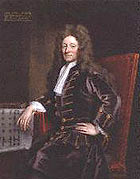 Sir Christopher Wren © We may trace the birth of the so-called 'scientific revolution' in Britain to the activities of three influential figures, all of whom flourished around the year 1600, and all of whom belonged to an exclusive inner circle of advisers to the royal family of the day, Elizabeth I, James I, and above all James's eldest son Prince Henry (who died in adolescence).
Sir Francis Bacon (1561-1626), often called the 'Father' of modern science, made no major scientific discoveries himself, but wrote extensively on empirical scientific method - the procedures by which experimentalists could arrive at general laws governing the natural world. He served as Lord Chancellor under James I, but was disgraced in 1621 for accepting bribes from clients, and retired to his estate, where he published his major work, the Novum Organum (1623). In this he expressed the classic view that only by following the laws of nature could man triumph over his environment: 'The empire of man over things depends wholly on the arts and sciences. For we cannot command nature except by obeying her.'
It is to Bacon that we owe the strong strand of pragmatism in 17th-century British science. Western scientific progress, he argued, was built upon a foundation of three key technological discoveries, which had changed man's ability to control the natural world. These three were printing, gunpowder, and the magnet. 'For these three have changed the whole face and state of things throughout the world, insomuch that no empire, no sect, no star seems to have exerted greater power and influence in human affairs than these mechanical discoveries.' (Voltaire, an admirer of Bacon, later added the invention of glass to the three discoveries, as fundamental to the advancement of knowledge.)
William Gilbert (1544-1603) was court physician to Elizabeth I and (briefly) to James I. In his 'De magnete' [On the magnet] (1600), written ten years before Galileo published his 'Starry Messenger' (1610), Gilbert proposed that the earth was a giant magnet or lodestone, with its poles at either geographical pole. He argued that the earth rotated about its axis because of terrestrial magnetism.