
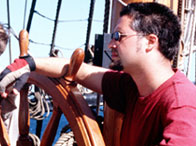
Sailing aboard the Endeavour, Australian historian Alex Cook saw his home from Captain Cook's perspective and gained insights into the Aboriginal point of view. Here he reveals a uniquely personal account of his country's history.
By Alex Cook
Last updated 2011-02-17
Sailing aboard the Endeavour, Australian historian Alex Cook saw his home from Captain Cook's perspective and gained insights into the Aboriginal point of view. Here he reveals a uniquely personal account of his country's history.
As a European Australian, it has been a rare privilege to explore my country from the perspective of its first British explorers. Sailing up the Eastern coastline, retracing Cook's route in a reproduction of Cook's ship proved a strange and moving experience. While an opportunity to visit one of the most beautiful and remote parts of this isolated continent was, in itself, the chance of a lifetime, the context in which we did it added enormously to the richness and the depth of the encounter. In keeping with the spirit of the original voyage, however, our adventure was not without its ordeals. For me these were both personal and professional.
It is difficult, perhaps impossible, to study the Cook voyages without emotional attachment.
There were, of course, the obvious trials of adapting to maritime life - the discipline, the horrendous food, the unfamiliar blisters on pampered academic hands. There was the nagging fear of death as we climbed the rigging at night and the cloying stench of forty bodies snoring below deck in the tropical heat. Yet there were also challenges relating to my responsibilities as a historian and the need to do justice to a complex and controversial chapter of modern history. Over time, these issues forced an increasingly personal encounter with my country's past.
It is difficult, perhaps impossible, to study the Cook voyages without emotional attachment. For Australians and New Zealanders in particular, his voyages lie at the core of our national mythologies and the issues they raise have ongoing practical relevance. Cook himself tends to be either glorified or demonised. Depending on your perspective, he is either a great contributor to human knowledge or an advance party for an invasion force. Disputes rage concerning Cook's personal vices and virtues as well as the extent to which the subsequent history of settlement is implicit in the moment of first contact. These disputes will certainly not be settled by our voyage. Indeed, our crew remains divided in its attitudes to the man and his legacy.
Cook had elements of greatness although he was no saint.
Personally, I have always felt uncomfortable with the veneration of Cook. He was a brilliant navigator, a talented cartographer and a relatively humane captain by the standards of his time. He was also, on occasion, an acute observer of social relations amongst the peoples he encountered, and he was ambivalent about his own role in furthering European exploitation of the Pacific. As a man he had elements of greatness although he was no saint. Yet the history of European exploration is a story of commercial ambition as much as of scientific curiosity, and the subsequent process of settlement was invariably marked by the violent dispossession of local populations. In the case of Australia, the prior occupants have yet to fully recover. For these reasons, it is hard to tell the story of Cook's expeditions with sensitivity and justice.
We were fortunate to have on board two Murri (Queensland Aboriginal) crew members - Bruce and Ricoh. We also met with tribal elders in Cooktown and Pajinka. Collectively, they helped to smooth our passage with the recently reinstated traditional landowners of North Queensland. They also offered some fascinating insights into what Cook means to the original population of Australia. More generally, they gave us a small window into life as an indigenous Australian - both traditionally and today. In doing so, they helped to focus our attention on some of the broader historical implications of the Cook voyages.
...indentured workers from around the Pacific were imported to produce sugar for the white man's table.
As we travelled up the coast, it was fascinating to compare the landscape with that described by Cook and Banks more than 230 years ago. We saw Cook's legacy in the miles of cane fields near Cairns, where indentured workers from around the Pacific were imported to produce sugar for the white man's table. Today they are worked by impoverished farmers who struggle to make ends meet.
 Alex Cook spent six weeks on board the 'Endeavour' © We saw Cook's legacy in the silica mines which dot the coast. It was Joseph Banks' discerning eye that first saw the industrial potential of these endless miles of white sand beaches. We saw Cook's legacy in the tourist resorts that continue to grow on the coral islets that so terrified the crew of the Endeavour, and in the towns that harbour fishing fleets and serve the pastoral industry of the interior. In all the signs of modern Australia it seemed possible to discern the impact of that one voyage.
Yet in this remote environment, it was striking how much remained unaltered from Cook's time to our own. The rainforests and mangrove swamps, the empty beaches and the myriad coral reefs seemed largely untouched by the generations of labour that had gone into building the nation. Here it seemed possible to see the country almost as Cook's crew saw it. Much of the flora stands as recorded in Banks' journal. The marine and bird life that followed the boat matched that observed by the Endeavour crew. The distant smoke from farmers clearing land seemed strangely reminiscent of the signal fires that followed the original ship's progress north. It was an eerie experience.
For perhaps the first time, I felt I understood just how strange and threatening this environment must have seemed to sailors raised in Portsmouth, Plymouth and the London docks. For all its beauty, it is no wonder that it seemed the end of the earth to those who would later use it as a refuse dump for criminals - and to the criminals themselves who would become our founding fathers.
Australia was never a wilderness, of course, or at least not for the past 60,000 years. Indeed, we are only just beginning to realise how profoundly the first waves of human settlement transformed the landscape. What Cook and his successors viewed as a vacant land waiting to be tamed by the hand of industry was in fact a carefully maintained eco-system, cleared by the use of fire and managed by controlled hunting. When we spoke with our Murri crewmen about the history of this process it was clear that many of the techniques are still relevant. Indeed, it was encouraging to see that local authorities are increasingly consulting traditional landowners about strategies for environmental management. The use of selective burning to minimise the occurrence of raging bushfires is just one trick we have learnt from our Aboriginal brethren.
...there was impressive evidence of a determination to reclaim a culture that was almost lost...
A striking feature of all our contacts with the indigenous communities of the far north was their cultural and social vitality. While the problems of poverty are present there, as elsewhere, among the Murri and Curri population, there was impressive evidence of a dual determination to reclaim a culture that was almost lost and to build a future for themselves in modern Australia. In a strange historical twist, the carefully compiled records of Cook's voyage were assisting them with both tasks.
In Cooktown, for example, the Gogo-Yimidir people were using accounts from the 1770 voyage to demonstrate their historical presence in the region in order to reclaim land from the Crown under Native Title legislation. Similarly, vocabularies compiled by Cook's artist Sydney Parkinson (and others) were being used to reconstruct a local language that was nearly lost during 130 years of dispersion. It was fascinating to see the contemporary relevance of these antique documents. In a strange way, it confirmed my own interest in this history.
 Sailing the 'Endeavour' helped Alex re-evaluate Australia's history © Above all, as we spoke with the tribal elders of the far north, I was amazed by the conciliatory attitude of a population who have suffered enormously and continue to suffer. There was little interest in the vilification of Cook, and a surprising interest in the skills and technology that made possible his feats of seamanship. Our ship was a constant source of delight and people were eager to hear our theatrical tales of deprivation and despair. For most of those we met, as for me, our presence in that remote part of the country seemed a small opportunity for reconciliation - a chance to come to terms with our shared history and, in doing so, to move on.
For good or ill, we live in a world created by men like Cook...
It is fruitless, of course, to hold our ancestors responsible for a future they could not foresee. Nor should we smugly judge them by the light of our superior morality. I cannot honestly say, moreover, that I wish Cook's legacy erased. I am a product of a process he set in train, after all, and my country has many virtues as well as many faults. Despite its periodic xenophobia, it has offered a good life to immigrants from many lands and that is something of value. Yet in moving towards the future it is important that we remember both the errors and the achievements of the past. For good or ill, we live in a world created by men like Cook - a global world of commercial and cultural exchange. By learning how this world came to be, we may yet learn to rectify some of its failings.
Books
The Ship - Retracing Cook's Endeavour Voyage by Simon Baker (BBC Worldwide, 2002)
The voyage of the Endeavour: Captain Cook and the discovery of the Pacific by Alan Frost (Allen and Unwin, 1998)
Captain Cook by RT Gould and Gavin Kennedy (Gerald Duckworth and Co, 2002)
Captain Cook by Vanessa Collingridge (Ebury Press, 2002)
Andrew Cook worked as a foreign affairs and defence specialist, and was aide to former secretary of state for defence and secretary-general of NATO, Lord Robertson of Port Ellen, and John Spellar, the former minister of state for the armed forces. He is a regular contributor on espionage history to newspapers and magazines, and national television and radio. He is the author of Ace of Spies - The True Story of Sidney Reilly (2002), M: MI5's First Spymaster (2004) and To Kill Rasputin (2005).





BBC © 2014The BBC is not responsible for the content of external sites. Read more.
This page is best viewed in an up-to-date web browser with style sheets (CSS) enabled. While you will be able to view the content of this page in your current browser, you will not be able to get the full visual experience. Please consider upgrading your browser software or enabling style sheets (CSS) if you are able to do so.

