An uncertain young man
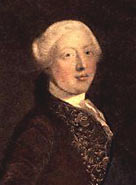
 Queen Charlotte c.1780 © In his adolescence - remarkably fully documented in George's letters to his tutor, Lord Bute - may be seen in outline the grown man. He was shy and unsure of himself, outshone by his younger brother Edward, and, with no father to advise him, painfully dependent upon Bute's good opinion. 'In what a pretty pickle I should be in a future day if I had not your sagacious counsels', he wrote to Bute at the age of 20.
He found public affairs so stressful that after only five years on the throne, he hinted at abdication or a Regency. As he grew older he gained in confidence, but audiences and levées remained something of an ordeal, and he masked awkward silences with his incessant verbal tic, 'What? what?'
He apologised profusely to Bute for his youthful indolence, and compensated later by painstaking dedication, endorsing his letters, not only to the hour, but to the minute. His assessment of himself was unassuming: 'I do not pretend to any superior abilities', he wrote, 'but will give place to no one in meaning to preserve the freedom, happiness and glory of my dominions and all their inhabitants'.
George's debut was encouraging. In his first public speech, prompted no doubt by Bute, he distanced himself from his German forebears, declaring that 'born and educated in this country, I glory in the name of Britain'. At his coronation he was dignified and impressive - well-built, with blue eyes, fair hair, and a pleasant manner.
The first great setback, in the king's opinion, came when, after no more than two years, Bute concluded that he could not face the rough and tumble of public life. George was devastated: 'I own I had flattered myself when peace was once established that my dearest friend would have assisted me in purging out corruption; then our memories would have been respected and esteemed until the end of time'. Reluctant to accept that Bute was now a broken reed, George maintained with him a private correspondence, which enflamed the suspicions of the remaining ministers and caused the king great difficulty.
Domestic worries
After 1784 the political situation became easier, with Pitt, more masterful than North, taking a greater share of the burden of government from the king's shoulders. The French Revolution of 1789, though full of menace, came to the king's aid, casting him as a rock of stability in a terrifying world.
His virtues were more readily acknowledged, particularly his calmness in the face of attempted assassinations - stabbed in 1786 by Margaret Nicholson, shot at in 1800 by James Hadfield in Drury Lane theatre. On his visits to Weymouth and Cheltenham in the 1780s he was cheered by large and enthusiastic crowds.
But if the political scene was a little easier, George's domestic problems were not. His severe illness in 1788-9, during which he was forcibly restrained as a lunatic, cast a dark shadow on the future, and ended only a few days before a Regency would have been declared. His sons were also a source of constant anxiety.
In 1781 he was forced to find £5,000 to retrieve the love-letters of his son George, Prince of Wales, to the actress 'Perdita' Robinson, and in 1785 the Prince went through a secret marriage to Mrs.Fitzherbert which, if made public, could have cost him the throne. When debt forced the Prince to make a legal marriage in 1795 to his cousin Princess Caroline of Brunswick, it brought nothing but embarrassment and unpleasantness to the king and the royal family.
Prince William (the future William IV) joined in the clamour for increased allowances, before settling down in 1790 with another actress, Mrs Jordan, and producing a large brood of illegitimate children (the Fitzclarences).
In 1793 a third son, Prince Augustus, went through yet another secret marriage, which was disallowed. George's daughters were protected from similar contagion by a watchful regime presided over by their mother, leading the Princess Royal to complain that Windsor was like a nunnery, and to wonder why she and her sisters were not drowned like unwanted puppies. The king was an affectionate father, but had not the understanding to appreciate the princesses' stifling existence.
Descent into darkness
George's preference was for a quiet, domestic life, though he enjoyed visits to the theatre (especially farces), and found great pleasure in music, particularly that of Handel. He took an intelligent interest in scientific matters, amassed a splendid library (which went eventually to the British Museum), and added greatly to the royal collection of paintings. But he was most at home at Windsor, where in the daytime he hunted or busied himself by keeping an eye, as 'Farmer George', on his estate. In the evening he enjoyed playing cards with his friends.
He had no great liking for London - 'I am never a volunteer there' - and showed remarkably little interest in the rest of his dominions, never visiting Hanover, Wales, Ireland or Scotland, or even the north and midlands of England. Politically his influence was conservative. He was keenly conscious that the Hanoverian family had been brought over to safeguard a protestant monarchy and that, in his coronation oath, he had sworn to uphold the Church of England. This obliged him to disapprove of concessions to the Catholics and led to the resignation of Pitt in 1801.
Though he lived until 1820, five years after the Battle of Waterloo had ended the long struggle against Revolutionary and Napoleonic France, this success meant nothing to him. On the very day of his Golden Jubilee (23 October 1810) there were ominous signs of mental derangement, and soon he was once more in the hands of what were known in his day as 'mad-doctors'.
Though at first there was hope that he would recover, he slowly lapsed into a twilight world, hard of hearing and going blind. His wife, Queen Charlotte, ceased to visit him at Windsor, and her death in 1818 was beyond his comprehension.
It was left to Sir Lewis Namier, in 1953, to start the process of rehabilitation of George III, in a moving lecture on the king's personality. 'What I have never been able to find', Namier concluded, 'is the man arrogating power to himself, the ambitious schemer out to dominate, the intriguer dealing in an underhand fashion with his ministers.' The treatment of George III, by the public of his day, by politicians and by historians, is a warning of how easily malice and prejudice can, in the words of JW Croker, poison the wells of history.