
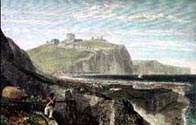
For more than a decade, Britain faced the prospect of invasion by Napoleon. But how real was the threat and what defensive preparations did the British make?
By Dan Cruickshank
Last updated 2011-02-17
For more than a decade, Britain faced the prospect of invasion by Napoleon. But how real was the threat and what defensive preparations did the British make?
When war broke out between Britain and Revolutionary France in the spring of 1793 there was no immediate threat of French invasion. Britain relied on the Royal Navy for defence and planned a series of sorties against the French forces in mainland Europe. But the picture started to change in 1796. French military successes and British military frustrations started to alter the balance of power and the British Government began to repair and reinforce coastal defenses and to raise, train and equip a huge force of volunteers.
...the British Government began to repair and reinforce coastal defenses and to raise, train and equip a huge force of volunteers.
During 1796 the most successful and charismatic of France's revolutionary soldiers - General Hoche - started to hatch a grand and complex plan for the co-ordinated invasion of England, Wales and Ireland. Important to the French was the Irish patriot Theobald Wolfe Tone. A member of the Society of United Irishman Wolfe Tone was a Protestant who by the mid 1790s was convinced that change could come only through violent insurrection. In 1796 he was in France seeking aid and promoting the invasion of Ireland by a French army of liberation.
Wolfe Tone and Hoche met and their aspirations coincided. Wolfe Tone promised popular support if the French invaded and, in late December 1796, a French invasion fleet of around 50 ships carrying 15,000 veteran troops set sail from Brest for Bantry Bay in south-west Ireland. The plan was to land, ignite the country in rebellion against the Protestant English overlords, seize the port of Cork and be in Dublin within the fortnight. But nothing went right for the French - the weather was so violent that no troops could be put ashore - and by the first week of January 1797 the French invasion fleet, battered and dispersed, crept back to Brest.
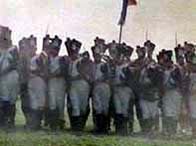 Reconstruction of soldiers during the Napoleonic wars © The failure of this and other invasion plans brought the British only a short-term reprieve. The Government continued to fear the enemy within and increased the power of sedition laws to break and stifle individuals and societies that appeared to be supporting pro-French Republican views. These fears seemed to be fully realised in April and May 1797 when elements of the Royal Navy - the first and major bulwark against invasion - mutinied at Spithead and the Nore. The mutiny - not primarily political in its nature - was dealt with and the British naval victory in October 1797 over a French-led and sponsored Dutch invasion fleet at Camperdown suggested that the Royal Navy was still in possession of its fighting spirit. But despite this British success the French still appeared to be closing in for the kill. General Hoche - the champion of invasion - died in mysterious circumstances in September 1797 but General Napoleon Bonaparte, whose prestige and power were rapidly on the rise following his victories in Italy, took up Hoche's anti-British and pro-invasion policies.
Napoleon Bonaparte, whose prestige and power were rapidly on the rise following his victories in Italy, took up Hoche's anti-British and pro-invasion policies.
In late 1797 Bonaparte declared to the Directory Government that France 'must destroy the English monarchy, or expect itself to be destroyed by these intriguing and enterprising islanders... Let us concentrate all our efforts on the navy and annihilate England. That done, Europe is at our feet.'
When 1,100 French soldiers - led by General Jean Humbert - landed at Killala Bay on the 22nd August 1798 they came too late. The Irish were too demoralised or too terrified to join the French would-be liberators and Wolfe Tone - who could perhaps have raised more resistance in Ireland - was captured en route by the Royal Navy and subsequently committed suicide while waiting execution as a traitor. In early September Humbert surrendered his tiny army which - although the invasion proved futile - had given a good account of itself. But it was not Humbert's surrender that saved England from immediate invasion; that had been achieved before Humbert even set foot on the British Isles.
On the 1st August 1798 Admiral Nelson had destroyed a French fleet in Aboukir Bay - an action which not only marooned Bonaparte and his army in Egypt but also removed from France the ability to defend an invasion army as it crossed the English Channel. In March 1802 Britain appeared to have weathered the storm when, with the Treaty of Amiens, France - now a dictatorship with Bonaparte as the autocratic head-of-state - made peace with Great Britain. But both sides were intensely suspicious of each other, the terms of the treaty were not honoured and, in May 1803, Britain was once more at war with France, more powerful and a more sinister enemy than ever before.
By the end of 1803 Bonaparte had amassed on the cliffs around Calais an Army of England 130,000 strong and a flotilla of 2,000 crafts to carry the host across the Channel. The presence of the army put huge pressure on the British Government to come to terms with Bonaparte who, in May 1804, had his position strengthened still further by getting the French senate to confer upon him the title of Emperor Napoleon I.
Napoleon realised that with invasion, as with most things, time was of the essence.
Napoleon realised that with invasion, as with most things, time was of the essence. If he could get his men ashore, getting them moving and to London before the British could fully mobilise or deploy their forces then victory would be his. The British also realised that timing was all important and knew that the job of its land-based defences - both coastal fortifications and volunteer regiments - was to delay and disrupt enemy forces until British regular forces could be gathered and a counter-attack launched. In the dark days of 1803 and 1804 - when a French invasion was expected on an almost hourly basis - Britain started to construct a vast network of coastal defences as well as relying on the skill and resilience of the Royal Navy. As Admiral Earl St Vincent said at the time: 'I do not say the French can't come, I only say they can't come by sea.'
The British reckoned the French would almost certainly choose the shortest invasion route and that they would aim to land at, or near, a port which, if captured, could be used for the rapid reinforcement and re-supply of its army. This pointed to three prime invasion targets: Dover and the beaches around it, Chatham and the River Medway (which the Dutch has successfully raided in 1667) and the flat, wide beaches of the Romney Marsh adjoining the small port at Rye. So Prime Minister William Pitt, a firm believer in the benefits of fixed fortifications, followed the advice of a number of military engineers, notably General Twiss, and approved plans to strengthen the defences of these prime targets.
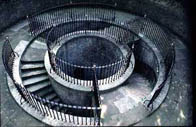 The Grand Shaft, designed so that troops could move from Dover's Western Heights to the harbour © The lines defending Chatham from land attack were strengthened by additions to Fort Amherst and by the construction of Fort Clarence. The greatest weakness of Dover was vulnerability to land attack. The ancient castle - despite being greatly strengthened during the 1790s - was also vulnerable to attack from land, especially from the neighbouring Western Heights from which modern artillery could rapidly reduce the castle to ruins.
The answer hit upon by the military was to transform the Western Heights from the weak link in Dover's defence into its greatest strength. From 1804 until 1814 was turned into one of the great artillery fortresses of Europe. It housed batteries firing out to sea and inland, and barracks for a large garrison of troops that was given rapid access to the sea by means of the spectacular Great Shaft, a 140 foot deep cylinder containing three staircase designed to allow troops to move to and from the Western Heights and the harbour with maximum speed. The Western Heights was also provided with an impressive strong point - a place of great defensive and offensive power - called the Drop Redoubt. This fortress with its massive, brick-clad earth walls, deep ditch, well sited gun embrasures and vastly strong casemates and magazine remains one of the wonders of British post-medieval military design.
The greatest weakness of Dover was vulnerability to land attack.
The defence of the Romney Marches was a trickier problem. Flooding was one possibility but this would have destroyed many homes and much productive land. In late 1804 a Royal Engineer colonel John Brown came up with a better idea: dig a 62-foot wide canal along the north edge of the march; keep its water level high with the use of sluices; and build a military road and rampart along its north bank so that it would function as a defended moat in case of French attack. The idea was approved immediately by Prime Minister William Pitt and the Royal Military Canal was completed by 1809. Its construction was a colossally expensive exercise - £234,310 - and was subsequently much mocked as an act of absurd military folly. William Cobbett's reaction in 1823, in his Rural Rides, was typical; 'Here is a canal ... made for the length of thirty miles ... to keep out the French: for those armies that had so often crossed the Rhine and the Danube were to be kept back by a canal.' Cobbett had a point but he missed the main one: the canal was only a part of a co-ordinated system of defence intended to wrong-foot the French invader, not to stop him.
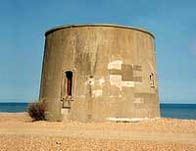 Martello Tower, number 66, at Langney Point near Eastbourne © A similar purpose lies behind another of Britain's great, and much misunderstood, Napoleonic defences - the chain of 103 Martello Towers stretching from Seaford in the west to Aldeburgh on the East Anglian coast built between Spring 1805 and 1812. These squat, ovoid-shaped brick-built towers are immensely strong and were modelled on a gun tower at Martella, Corsica that had caused the Royal Navy much trouble in 1794.
Martello Towers were the idea of Captain William Ford of the Royal Engineers and they were sited roughly 600 yards apart and each mounted a long-range 24 pounder cannon. The aim was to cover the most likely landing beaches and to confuse any French landing while British reserves and Royal Navy ships were rushed to the area.
These squat, ovoid-shaped brick-built towers are immensely strong...
These towers were never tested which is a great tribute. The best defence is that which deters attack and certainly the French regarded these little 'bulldogs' as a formidable barrier. With hindsight it appears that all these defences were, essentially, pointless since Nelson's victory at Trafalgar in October 1805 - at the very moment the construction of the Martello Tower system was getting under way - made a French invasion of Britain a virtual impossibility.
But in late 1805 the picture was not quite so clear. After the destruction of his fleet at Trafalgar Napoleon went on to win, in December 1805, the vastly important victory at Austerlitz that confirmed the French as the military and political masters of Europe. A French fleet could be reconstructed and, as far as the British could see, it was just a matter of time before the French were again in a position to invade. It was not until 1812 when Napoleon and his allies were smashed in Russia that the invasion of Britain was clearly beyond the French - and in this year the construction of the chain of Martello towers ceased.
The victory at Waterloo in 1815 left Britain the dominant power in Europe with the Royal Navy the strongest fleet in the world - despite suffering a series of significant but small-scale reverses during the War of 1812 with the fledgling United States Navy. For 40 years threats of invasion were forgotten but then, in the late 1850s, emerged in a sudden and most dramatic manner. France - revived as an empire with immense territorial ambitions under Napoleon III - was once again the enemy and in the late 1850s Britain led by its Prime Minister Lord Palmerston undertook to spend vast sums on defence.
In 1859 a Royal Commission recommended the protection of Britain's main dockyards on both seaside and landward approaches with massive new forts being constructed at Portsmouth, Saltash, Plymouth, Milford Haven, Sheerness and Chatham. The total cost of these works - mostly completed during the 1860s - was a staggering $11.6 million, equal to around £520 million in modern money.
The speedy defeat of France by Prussia in 1870 and the ridiculous light it shed on the military worth of Britain's new and expensive generation of fortifications did not end the British fear of invasion. On the contrary, it merely identified a new enemy. Initially the British had been gratified by the discomfiture of their traditional enemy but by the end of 1870 Prussian brutality, its cold-blooded military efficiency and its territorial ambitions had made it the next potential invader.
Books
A Guide to the Western Heights Defences, Dover, Kent by D. Burridge (Kent Defence Research Group, 1993)
Towers of Strength - The Story of Martello Towers by B. Clements (Pen & Sword, 1998)
Napoleon on Napoleon by S. de Chair (Brockhampton Press, 1992)
Britain at Bay: Defence against Bonaparte, 1803-14 by R. Glover (George Allen & Unwin, 1973)
Trafalgar: The Nelson Touch by D. Howarth (Collins, 1969)
Defending the Island by N. Longmate (Hutchison, 1983)
Invasion: From the Armada to Hitler, 1588-1945 by F. McLynn (Routledge and Keegan Paul, 1987)
The Life of Theobald Tone by W.T.W. Tone (Degeur Editions, 1998)
Journal of Maritime Research, National Maritime Museum is an interesting resource on a wide range of maritime subjects, historic and current. The JMR site is part of the Greenwich National Maritime Museum site.
Encylopedia Britannica has a lot of useful information, including an article on the Battle of Waterloo and a section on Napoleon Bonaparte.
The Warfare in the Age of Sail site gives lots of information including a section on Nelson's exploits from the Wargamer.
The Nelson Society site has lots of information about the man and his battles.
Visit HMS Victory - visitor information from Flagship Portsmouth at the Historic Dockyards.
Dover Castle - English Heritage site gives information of how to get there and what to expect.
Use this map provided by The South Coast Martello Towers site to visit the towers themselves.
[The BBC is not responsible for the content of external websites.]
Dan Cruickshank is one of the country's leading architectural and historic building experts and a regular presenter on the BBC. He is an active member of the Georgian Group and the Architectural Panel of the National Trust and director of the Spitalfields Historic Buildings Trust. Dan is a frequent contributor to The Architects' Journal and The Architectural Review and is author of Life in The Georgian City and The Guide to the Georgian Buildings of Britain and Ireland.





BBC © 2014The BBC is not responsible for the content of external sites. Read more.
This page is best viewed in an up-to-date web browser with style sheets (CSS) enabled. While you will be able to view the content of this page in your current browser, you will not be able to get the full visual experience. Please consider upgrading your browser software or enabling style sheets (CSS) if you are able to do so.

