
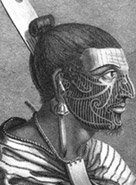
Although Captain Cook's mission to New Zealand and Australia didn't involve colonisation, the legacy of his voyage aboard the Endeavour, and of what came after, has been far-reaching. Merata Kawharu examines Cook's impact on Maori culture.
By Merata Kawharu
Last updated 2011-02-17
Although Captain Cook's mission to New Zealand and Australia didn't involve colonisation, the legacy of his voyage aboard the Endeavour, and of what came after, has been far-reaching. Merata Kawharu examines Cook's impact on Maori culture.
Captain Cook's voyages around the globe took him to remote parts - to the Pacific Island nations and to Aotearoa New Zealand (Aotearoa is Maori for 'Land of the Long White Cloud', an earlier name for New Zealand given by the Polynesian explorer Kupe, upon discovery of these lands about 1,000 years ago). Cook's arrival offered immediate benefits, both for the weary European travellers and for the Maori in New Zealand. Both parties, eager to capitalise on the opportunities offered by the arrival of the newcomers, traded material items, ideas, values and worldly information with each other.
The voyages themselves... had a more immediate impact on the Maori than on other indigenous peoples of the Pacific region...
Cook's erstwhile Polynesian associate, Tupaia, facilitated much of this. But it was not only goods and ideas that were exchanged. Less fortunate outcomes, including death, resulted from the meeting of the two groups, marring relationships between the Maori and Cook's people. In today's language, such circumstances have been put down to 'cross-cultural misunderstandings'. The net effect of these early meetings, however, and the subsequent intercultural relationships that developed in the late 18th and early 19th centuries in New Zealand, was the growth of distinct identities and the definition of new rules of encounter between the two groups. Not least, they were founding contributions - both positive and negative - to nationhood.
Such ideas were largely for the future. The voyages themselves were remarkable in their own right, and had a more immediate impact on the Maori than on other indigenous peoples of the Pacific region, although in the context of the history of travel in the southern seas of the Pacific, Cook could be considered a latecomer. Fast-forwarding some 230 years, the present writer is a Maori who has embarked on her own ethnographic voyage - in New Zealand and elsewhere around the world - and now offers her own perspective on the range of assumptions that underpinned Captain Cook's journeys to the southern Pacific, on the cross-cultural relationship-building mediated by Cook and Tupaia, and on the impact of each culture upon the other. Put simply, this piece considers the role played by Cook in the formation of modern-day New Zealand.
Abel Tasman was the first European to venture to Aotearoa, or New Zealand, in 1642, but he did not take the opportunity to land and enjoy the bounty of the place - plentiful food and other resources that Maori people had found out about more than 600 years previously. Nor did he take advantage of the local hospitality that might well have been offered him. Instead, some of his crew engaged in a skirmish with the Maori, which resulted in the deaths of some of the newcomers. It is possible that Spanish voyagers had already found their way to these parts and had better experiences, as there are some tribal traditions that tell of meetings between Maori and either Spanish or Portuguese visitors, although little detail is known.
Cook's original mission, as organised by the Royal Society of London, was not a colonising one...
After Tasman, the first major encounters between Maori and Europeans were those that involved Captain Cook's voyages, beginning in early October 1769 when he landed at Turanganui on the east coast of the North Island. This was the place he named Poverty Bay, being unable to find adequate provisions there, despite there being an abundance of fish, forest, cultivated foods and water. Not too far away from his landing point, he could have found fertile gardens, making patchwork out of hillsides, like those that he and his crew discovered when they landed elsewhere in New Zealand.
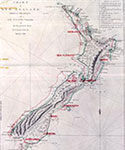 Cook's chart of New Zealand was surprisingly accurate © Cook's original mission, as organised by the Royal Society of London, was not a colonising one, in contrast to that of the British agents Hobson and Busby later on in the 1830s. He had rather more immediate concerns:
1) to observe the transit of the planet Venus (and so work out the distance between the earth and the sun), and 2) to look for the 'great southern continent'.
His was a voyage of discovery and exploration beyond the northern seas and into the Pacific. And why should he not have made such a voyage? Polynesian navigators, known as the Te Rangi Hiroa, or Vikings of the Pacific, had been doing the same exploratory journeys throughout the Pacific for many hundreds of years before him.
Guided by the stars, currents, swells, migratory birds and other signs of nature, the Polynesians had mapped their oceanic world, and plotted pathways and courses that enabled return trips - not only to nearby islands and atolls, but to lands hundreds of miles away. The explorer Kupe and his contemporaries, for instance, made successive trips to New Zealand from their Pacific homelands around Tahiti.
Tupaia, the legendary leader of the Polynesian island of Raitea, was brought to meet Captain Cook during the early part of his first voyage, while the Endeavour was moored near Tahiti. Cook had heard about Tupaia, who was an expert in geography, navigation and spiritual matters, through Banks, and it was at Banks' insistence that the Raitean was welcomed on board as an additional member of the crew. For his part, Tupaia was eager to embark on a journey of exploration to new places and, like his ancestors before him, to learn about new modes of adaptation and survival. As a leader of his society, his motivation would have been not only personal and short term, but also more long term, with his people's future in view - whatever knowledge he gained on the trip he would have wanted for his people's benefit, such were the values inherent in the kin-based Polynesian society. Leaders of such societies were accountable to their people, and vice versa, with systems of penalties and rewards limiting autocracy.
...as a result of misunderstandings, violence broke out and Maori were killed.
Tupaia, although focused on the personal and community benefits he might acquire through the voyage, had talents and skills of leadership that were soon made obvious as the journey progressed, not only in navigation, but also, on arrival in New Zealand, in mediating between the Maori and members of Cook's crew. Unfortunately, Tupaia was not present during the first meeting of Captain Cook with Maori people in Turanganui (Gisborne), and as a result of misunderstandings, violence broke out and Maori were killed.
At other times, Tupaia engaged in very fruitful dialogue with Maori people, when it was discovered that he came from the same spiritual homeland (or Hawaiki) as they did. This land included Raitea, where Taputapuatea, the sacred ceremonial courtyard (or marae) is located, and its people shared the same ancient genealogy, beliefs and values as Maori. Their languages were also very similar, which made free dialogue quite easy. Tuapaia's fame was so great among the Maori of New Zealand, that it was said news of him reached some parts of the country even before his arrival.
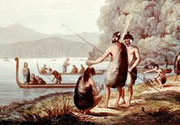 Maori at Queen Charlotte Sound, which was named by Cook © The earliest exploration of the Pacific region was not necessarily antithetical to colonisation. The Polynesian navigators, like the Dutch, English, French and many others after them, explored whatever new lands they discovered, and systematically colonised those lands. Cook was sponsored by, and under specific instructions from, the Royal Society in London to see what territory there was waiting to be discovered in the southern hemisphere, because it was thought a great mass of land could lie there that might balance the mass of the northern hemisphere. Such land, if it existed, was presumed to be waiting to be exploited, but Cook was a naval man and primarily keen on exploration, so he left matters of politics to others - including consideration of how new lands were to be colonised.
Titahi made a prophesy just prior to Cook's arrival, saying that major change was about to occur...
Although Cook paved the way for colonisation, and may have contemplated the prospect of a formal settlement, he did not envisage the nature of that settlement and the subsequent land 'deals' - nor the consequent turmoil amongst Maori kin communities, fighting to protect their land from British muskets or the colonists' legislative pen. By contrast, Titahi, a seer of the Ngati Whatua tribe in Tamaki Makaurau (where the future Auckland city was to grow), made a prophesy just prior to Cook's arrival, saying that major change was about to occur - involving new people, new ideas and new systems of power and control.
He aha te hau e wawa ra, e wawa ra? He tiu, he raki, he tiu, he raki Nana i a mai te puputara ki uta E tikina e au te kotiu Koia te pou whakairo ka tu ki Waitemata Ka tu ki Waitemata i oku wairangitanga E tu nei, e tu nei!
What was the wind roaring yonder? It was the north wind [the Treaty and its promises], the wind from the north The north wind, [news of] which I brought Hence the carved post [of a government meeting house] Standing at Waitemata Standing thus in my dreams Standing, standing!
The British Crown, as well as settlers, soon recognised and desired the gardens and fertile lands that Cook found in abundance in New Zealand. Tamaki Makaurau (which means 'Tamaki of 100 Lovers'), later called Auckland, was aptly named, as many tribes were drawn to the rich isthmus, where they established villages and cultivated land on the volcanic cones, valleys and bays of the area. In the first stages of colonisation, and having been invited by the Ngati Whatua leaders, the British likewise set up their own government and settlement there.
Cook certainly provided opportunities for scientific exploration and trade, but Tupaia was an equally significant figure in the eyes of many Maori. He can be considered the first Polynesian ethnographer, collecting information about cultural similarity and difference within Polynesia, particularly among Maori. And despite having only a limited dialogue with Captain Cook and the rest of the crew, he played an important role in helping Banks compile the first detailed ethnographic account of Maori. As well as this, he set an example to his people in taking every opportunity to learn about other parts of the world.
Hongi Hika wanted to acquire the means of power that would help to build his own personal prestige and also that of his people.
Maori quickly followed his example when whalers, sealers and others came from Europe to New Zealand, providing opportunities for Maori, in their turn, to sail to Sydney and London. Hongi Hika, a formidable figure from the northern Maori tribe Ngapuhi, was among those who went to England in 1820. He sought an audience with the King of England, worked on a Maori dictionary at Cambridge, and acquired muskets in Sydney on his way home. His motivation for all this was quite simple: he wanted to acquire the means of power that would help to build his own personal prestige (mana) and also that of his people.
Cook's voyages were significant in many respects, and information about each other's culture and knowledge was shared between Maori, Cook and other members of the crew. Maori may have had an initial impression of Cook and his crew as fairy folk (tipua), from the sea (a tale similar to some found among Australian Aboriginal people), but as time would tell, he and those who came after him caused far-reaching changes well beyond the capacity of most fairies.
Books
The Ship - Retracing Cook's Endeavour Voyage by Simon Baker (BBC Worldwide, 2002)
Endeavour: the story of Captain Cook's first great epic voyage by Peter Aughton (Windrush Press, 1999)
Maori and Pakeha Perspectives of the Treaty of Waitangi by I Hugh Kawharu (Oxford University Press, 1989)
We the Navigators by David Lewis (AH and AW Reed, 1972)
Captain Cook's World: Maps of the Life and Voyages of James Cook RN by John Robson (Random House, 2000)
Vikings of the Pacific by Te Rangi Hiroa (University of Chicago Press, 1959)
Ka Whawhai Tonu Matou: Struggle Without End by Ranginui Walker (Penguin, 1990)
Two Worlds: First Meetings Between Maori and Europeans by Anne Salmond (Viking, 1991)
Dr Merata Kawharu is Research Fellow at The James Henare Maori Research Centre, University of Auckland, where she is working on Maori development and policy research.




BBC © 2014The BBC is not responsible for the content of external sites. Read more.
This page is best viewed in an up-to-date web browser with style sheets (CSS) enabled. While you will be able to view the content of this page in your current browser, you will not be able to get the full visual experience. Please consider upgrading your browser software or enabling style sheets (CSS) if you are able to do so.

