
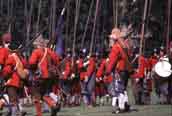
The west of England was a hotbed of action during the Civil War. Dr John Wroughton examines why Gloucestershire, Somerset and Wiltshire were so fiercely contested by both royalists and parliamentarians.
By Dr John Wroughton
Last updated 2011-02-17
The west of England was a hotbed of action during the Civil War. Dr John Wroughton examines why Gloucestershire, Somerset and Wiltshire were so fiercely contested by both royalists and parliamentarians.
...no more than 20-25% of the adult males in the country actually fought...
The counties of Gloucestershire, Somerset and Wiltshire were of prime importance during the Civil War for the supply of food, uniforms and munitions. The area also controlled vital routes by road and river and the three lucrative ports of Bristol, Minehead and Gloucester. It is hardly surprising, therefore, that the western counties were fiercely contested and constantly alive with the movement of troops. It should be remembered, however, that the war was not a total war in the modern sense, involving the whole population, but rather a war between two competing armies which manoeuvred around the country fighting occasional battles, frequent skirmishes and numerous sieges. Indeed, it is estimated that no more than 20-25% of the adult males in the country actually fought at some time in the war.
Nevertheless, many families in the western counties found themselves caught up in the conflict. When war came, divisions rapidly appeared. Families were torn apart. During the storming of Wardour Castle in 1644, for instance, a royalist musketeer named Hilsdean was mortally wounded. As he lay dying, he suddenly realised to his horror that he had been shot by his own brother, who was a member of the parliamentarian garrison.
Neighbours were torn apart. Sir William Bassett, Lord of the Manor at Claverton, decided after much wavering to support the king - but the rector of the little church next door to the manor house was Humphrey Chambers, a firebrand puritan and a keen supporter of parliament.
Friends were torn apart. When Sir William Waller commanded parliament's forces at the Battle of Lansdown in 1643, he came face-to-face on the battlefield with his lifelong friend, Sir Ralph Hopton, who led the royalist army.
Counties were torn apart. Somerset was parliamentarian in the north and royalist in the south. Although all sixteen of the MPs who represented the county had criticised the king and his policies when the Long Parliament met in 1640, only five of them actually fought against him when it came to war in 1642.
Divisions in the three western counties were quickly evident from the start of the war. A large area, consisting of north Somerset, west Wiltshire and south Gloucestershire, was solidly parliamentarian in sympathy - together with most of the ports and the clothing towns, which were largely puritan in religion. Outside these areas, a haze of neutralism or moderate royalism prevailed, inspired by a number of well-established families, who did their best to collect together men and money for the king. Even before Charles I had finally raised his standard at Nottingham in August 1642 to signify the official start of hostilities, both king and parliament had made a dash to control Somerset and Wiltshire. When, however, the Marquis of Hertford arrived with the king's commission to raise the county forces on his behalf, he was met by a spontaneous rising of some 12 000 local people at Chewton Mendip, who duly drove him out of the area.
...Somerset and Wiltshire were largely under the control of parliament...
By November 1642, therefore, Somerset and Wiltshire were largely under the control of parliament with small garrisons established in most of the towns. Gloucestershire, on the other hand, remained mostly uncommitted until February 1643, in spite of a number of pockets of active puritans working for parliament. Suddenly, however, the situation was changed by the arrival of strong royalist forces from outside the area, who began to make rapid inroads. A fierce struggle for control therefore took place. Two factors were responsible for this change. First, the king established his headquarters at Oxford in November 1642, which enabled him to make powerful thrusts into both Wiltshire and Gloucestershire. This led to the capture, for instance, of Marlborough, Malmesbury, Devizes, Salisbury and Cirencester.
Secondly, the balance of power was affected by the arrival of Sir Ralph Hopton's new royalist army from Cornwall into Somerset in June 1643 - part of an advance aimed ultimately at combining with the king for an attack on London. This army swept through the county, establishing garrisons at Bridgwater, Dunster and Taunton. Meanwhile, parliament had despatched an army of its own under Sir William Waller to strengthen the resistance of local forces and to halt at all costs this advance on London.
...the royalists totally routed Waller's men...
The two armies eventually met in two open-field battles in July. The first was a fairly indecisive battle at Lansdown, just outside Bath, which saw the royalist forces badly mauled as they foolishly attempted an assault of the northern ridge. The second (essentially a cavalry battle) took place a few days later on the flat top of Roundway Down, near Devizes. There, in a complete reversal of fortune, the royalists totally routed Waller's men as they fled across the down, many plunging to their deaths down the steep gullies of Oliver's Castle. This success enabled Hopton (now strengthened by Prince Rupert's reinforcements) to turn again westwards to capture both Bath and Bristol - the latter after a surprisingly short siege, which resulted in the parliamentarian governor (Colonel Nathaniel Fiennes) facing a charge of cowardice. The remainder of the western counties quickly fell into the king's hands - with the exception of Gloucester.
...the royalists were to remain in effective command of the western counties...
That city, under the defiant leadership of Colonel Edward Massey, survived a 27-day siege in August 1643, when a garrison of just 1400 men faced the king's own army of some 30 000. The citizens, who toiled ceaselessly on the fortifications, suffered a fierce bombardment of grenades and incendiaries, before a relief army under the Earl of Essex finally arrived from London. Nevertheless, the royalists were to remain in effective command of the western counties throughout the following year, tightening their control by the establishment of a network of garrisons - including those at Berkeley Castle, Beverstone Castle, Sudeley Castle, Farleigh Castle, Nunney Castle, Dunster Castle, Bridgwater, Taunton and Bristol. The parliamentarian garrison at Wardour Castle, however, bravely withstood a three-month siege under its governor Colonel Edmund Ludlow until it was finally starved into surrender in March 1644.
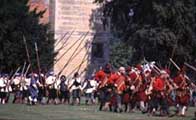 Civil War re-enactment © Meanwhile, Gloucester was proving to be a thorn in the king's side. From the summer of 1644, its governor (Massey) began to make raids on royalist strongholds in both Gloucestershire and Wiltshire. Between May and November he captured Beverstone Castle, Sudeley Castle, Malmesbury, Tewkesbury, Chippenham and Monmouth - not to mention a number of smaller garrisons which had been established in churches (such as those at Newnham-on-Severn and Westbury-on-Severn).
In Somerset, too, the royalists were coming under increased pressure. Robert Blake (later Admiral), for instance, captured Taunton for parliament and was to defy the odds by holding out most heroically during two prolonged sieges in 1644 and 1645. However, such was the intensity of the attack during the latter offensive that two-thirds of the town lay in ruins. The year 1644 also saw the movement of large armies from both sides as they crossed and re-crossed both Wiltshire and Somerset in pursuit of their campaign in Cornwall - movement which brought misery to countless towns and villages which lay in their path.
...first one side and then the other took possession.
Between December 1644 and May 1645, therefore, control of the three counties was again shared, as both sides established a host of rival garrisons to pin down particular sectors of the region. Many of these changed hands frequently, especially if they were based in 'open towns' with few formal defences - towns like Chippenham, Devizes and Salisbury, which saw bitter hand-to-hand fighting in December 1644, as first one side and then the other took possession. Other garrisons were set up in country houses such as Chavenage House, Lacock Abbey, Chalfield House and Littlecote House with additional strength provided by surrounding earthworks.
The final phase of the war in the west commenced with the arrival of parliament's new professional army (the New Model) in June 1645 under its commander, Sir Thomas Fairfax. This systematically returned the west into parliament's hands, partly through field battles (such as Langport and Torrington) and partly through sieges (such as Bridgwater and Bristol). It then went on to complete its mopping-up operation by claiming the surrender of a host of minor garrisons, before it accounted for the final remnant of the royalist field army at Stow-on-the-Wold in March 1646. It was there that the defeated commander, Sir Jacob Astley, smoking his pipe as he sat on a drum, uttered those prophetic words:
You have now done your work and may go play, unless you fall out among yourselves.
The war was over, but the cost to ordinary people in human suffering was immeasurable. Bled dry with taxes, they had also endured the compulsory billeting of uncouth troops in their houses, the plundering of their animals, the theft of their food, the disruption of their markets, the vandalisation of their churches and the destruction of their property. The lingering effects of the war were visible wherever you turned. One-third of the people in Gloucester were homeless; one-quarter in Bridgwater and two-thirds in Taunton. Hundreds of maimed soldiers and destitute widows submitted petitions to the county quarter sessions in the hope of gaining some relief. Fields lay abandoned; bridges broken down; and road surfaces destroyed. In 1646, on the anniversary of the relief of Taunton from siege, George Newton, the minister, looked around him and described in a sermon what he called.
her heaps of rubbish, her consumed houses, a multitude of which are raked in their own ashes. Here a poor forsaken chimney and there a little fragment of a wall that have escaped to tell what barbarous and monstrous wretches there have been.
It had indeed been an unhappy civil war.
Books
Gloucester and the Civil War by Malcolm Atkin & Wayne Laughlin (1992)
The Civil Wars in Britain & Ireland, 1638-1651 by Martyn Bennett (1997)
Going to the Wars: The Experience of the British Civil Wars, 1638-1951 by Charles Carlton (1992)
The Royalist War Effort, 1642-1646 by Ronald Hutton (1982)
For King and Parliament: Bristol and the Civil War by John Lynch (1999)
The Revolt of the Provinces by J S Morrill (1976)
Somerset in the Civil War & Interregnum by David Underdown (1973)
A Community at War: The Civil War in Bath and North Somerset, 1642-1650by John Wroughton (1992)
An Unhappy Civil War: the Experiences of Ordinary People in Gloucestershire, Somerset and Wiltshire, 1642-46 by John Wroughton (1999)
Dr John Wroughton was educated at Oxford University and is a Fellow of the Royal Historical Society. An authority on the English Civil War, he is now a part-time lecturer for the University of Bath's Department of Continuing Education. His publications include The Stuart Age, 1603-1714; and Cromwell and the Roundheads. His latest book, An Unhappy Civil War, describes the experiences of ordinary people in Gloucestershire, Somerset and Wiltshire during the Civil War, 1642-46.




BBC © 2014The BBC is not responsible for the content of external sites. Read more.
This page is best viewed in an up-to-date web browser with style sheets (CSS) enabled. While you will be able to view the content of this page in your current browser, you will not be able to get the full visual experience. Please consider upgrading your browser software or enabling style sheets (CSS) if you are able to do so.

