
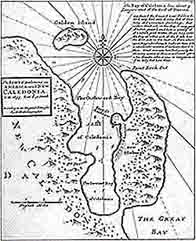
It began as an ambitious scheme to establish a Scottish colony in Panama, but ended in loss of life and financial ruin. So what really happened during the Darien Venture?
By Dr Mike Ibeji
Last updated 2011-02-17
It began as an ambitious scheme to establish a Scottish colony in Panama, but ended in loss of life and financial ruin. So what really happened during the Darien Venture?
Scotland at the end of the Seventeenth Century was in a state of crisis. Decades of warfare had combined with seven years of famine to drive people from their homesteads and choke the cities with homeless vagrants, starving to death in the streets. The nation's trade had been crippled by England's continual wars against continental Europe, and its home-grown industries were withering on the vine. Something had to be done. Some way had to be found to revive Scotland's economic fortunes before it got swallowed up by its much richer neighbour south of the border.
The man who came up with the answer was a financial adventurer called William Paterson, a Scot who had made his name down south as one of the founding directors of the Bank of England. Paterson returned to Edinburgh with an audacious scheme to turn Scotland into the major broker of trade across the Pacific Ocean. Whilst in London, he had met a sailor called Lionel Wafer, who had told him about a wonderful paradise on the Isthmus of Panama, with a sheltered bay, friendly Indians and rich, fertile land - a place called Darien.
Paterson had immediately seen the potential of Darien as the location of a trading colony. Trade with the incredibly lucrative Pacific markets was a hugely expensive business, since all merchant ships had to make the hazardous trip round Cape Horn on the southern tip of South America. This added months to the journey, and the ships involved had a high chance of being lost at sea. If a colony could be established at Darien, goods could be ferried from the Pacific across Panama and loaded onto ships in the Atlantic from there, speeding up Pacific trade and making it much more reliable. Moreover, the Scottish directors of the Darien Venture could charge a nice fat commission for the privilege. Never mind that the Spanish claimed control of that part of Panama: no-one ever made a profit without stepping on some toes.
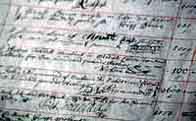 Signatures of some of those who subscribed to support the Darien Venture © The idea proved hugely popular, and there was a great rush to subscribe to the Company of Scotland Trading to Africa and the Indies, founded in June 1695; but it was not just the Spanish who felt threatened by it. The English East India Company, fearing the loss of its monopoly on British trade to the Indies, successfully lobbied the English Parliament, which threatened the new company with impeachment, forcing its English investors to withdraw.
Undaunted, Paterson and his colleagues turned to the Scottish people for support. Thousands of Scots, both rich and poor, flocked to subscribe, and within 6 months £400,000 had been raised. The money was used to fit out five ships for the expedition, the Unicorn, St Andrew, Caledonia, Endeavour and Dolphin, despite efforts by the English authorities to block them. The English ambassador to Holland even threatened to embargo any merchants who traded with the new company.
Thousands of Scots, both rich and poor, flocked to subscribe...
However, Lionel Wafer's stories of long-haired Indians living a life of luxury in a land of milk and honey had given the company's founders an unrealistic vision of what lay ahead. The cargo manifests of the first expedition list thousands of combs and mirrors, which they expected to sell to the Indians, along with boxes of wigs and other useless items which the colonists expected to use in their new life. They were completely unprepared for the ordeal which lay ahead.
The ships set sail from Leith harbour on 4th July 1698, under the command of Captain Robert Pennecuik. Of the 1,200 settlers in the first expedition, only he and William Paterson knew of their destination, which was outlined in sealed packages to be opened only once the ships were on the open sea.
They made landfall at Darien on 2nd November, having lost only 70 people during the voyage. Full of optimism, they named the peninsula New Caledonia, and set to work building a settlement. However, their first choice of site was, as Paterson put it: 'A mere morass, neither fit to be fortified nor planted, nor indeed for men to lie upon... We were clearing and making huts upon this improper place near two months, in which time experience, the schoolmaster of fools, convinced our masters that the place now called Fort St Andrew was a more proper place for us'.
Within the fort stockade, they began to erect the huts of New Edinburgh. However, they soon found that the land was unsuited to agriculture and the Indians were uninterested in the trinkets they had brought with them. Spring 1699 brought torrential rain, and with it disease. By March 1699, more than 200 colonists had died, and the death rate had risen to over 10 a day. To make matters worse, the ships sent out to trade for supplies returned with news that all English ships and colonies were forbidden to trade with the Scots by order of the King. One ship did not return at all. The Dolphin was captured by the Spanish and its crew imprisoned.
By March 1699, more than 200 colonists had died, and the death rate had risen to over 10 a day.
They were the lucky ones. Roger Oswald, a young gentleman who had joined the venture full of hope and optimism, wrote a harrowing account of what life was like that Spring on the Darien Peninsula. They lived on less than a pound of mouldy flour a week: 'When boiled with a little water, without anything else, big maggots and worms must be skimmed off the top... In short, a man might easily have destroyed his whole week's ration in one day and have but one ordinary stomach neither... Yet for all this short allowance, every man (let him never be so weak) daily turned out to work by daylight, whether with the hatchet, or wheelbarrow, pick-axe, shovel, fore-hammer or any other instrument the case required; and so continued until 12 o'clock, and at 2 again and stayed till night, sometimes working all day up to the headbands of the breeches in water at the trenches. My shoulders have been so wore with carrying burdens that the skin has come off them and grew full of boils. If a man were sick and obliged to stay within, no victuals for him that day. Our Councillors all the while lying at their ease, sometimes divided into factions and, being swayed by particular interest, ruined the public... Our bodies pined away and grew so macerated with such allowance that we were like so many skeletons.'
William Paterson's wife died on that peninsula, along with his dreams. The final straw was news that the Spanish were planning an attack on the colony. The settlers took to the sea in panic, abandoning the settlement. Of the four ships that fled the colony, only the Caledonia made it back to Scotland, with less than 300 souls on board.
A second expedition left Scotland in August 1699, knowing nothing about the fate of the first colony. Three ships, led by The Rising Sun, carried a further 1,302 settlers, of which 160 died in the crossing. Finding the colony abandoned, they set about rebuilding it; but the second colony fared no better than the first. The Revd Archibald Stobo, one of three Presbyterian ministers who accompanied the second expedition, was scandalised by the barbarity of the colonists. 'Our land hath spewed out its scum...' he wrote, 'We could not prevail to get their wickedness restrained, nor the growth of it stopped...' He viewed the sickness and contagion which plagued the colony as the just judgement of God.
In fact, his judgement is harsh. The men and women sent out to Darien were completely unprepared for the harshness of the territory in which they found themselves, and the collapse of discipline and rampant disease which afflicted them were the natural consequence of their altered circumstances. On top of this, they faced the constant threat of attack from the Spanish, with absolutely no support from the English colonies which had been ordered not to aid them.
The men and women sent out to Darien were completely unprepared for the harshness of the territory in which they found themselves...
Seeing this, one newly-arrived young officer, Captain Alexander Campbell of Fonab, persuaded the colonists to launch a pre-emptive strike against the Spanish forces massing at Toubacanti on the mainland. The attack was outrageously successful, but only served to sting the Spanish into concerted action. Under the command of Governor-General Pimiento, a massive fleet and army besieged Fort St Andrew, which finally surrendered in March 1700. The surviving colonists were permitted to vacate the fort on board their remaining ships. Only a handful ever made it back to Scotland.
The Darien Venture was a complete disaster for Scotland. The blow to Scottish morale was incalculable. Those colonists who returned found themselves cast as pariahs in their own land. Roger Oswald, disowned by his father, wrote to a friend: 'Since it pleased God that I have preserved [my life], and had not the good fortune (if I may term it so) to lose it in that place, and so have been happy by wanting the sight of so many miseries that have come upon myself... I never intended, nor do intend, to trouble my father any more.'
William Paterson found himself forced to defend his actions. He partially vindicated himself with a no-holds-barred account of the colony. Some years later, he was granted a pension of £18,000, but he died a deeply disillusioned man. Only Campbell of Fonab came out of the affair with honour. He made it back to Scotland, where he was awarded the 'Toubacanti Medal' for his part in the débacle, but he never stopped blaming the Company for failing to support its colonists.
Those colonists who returned found themselves cast as pariahs in their own land.
It was an economic disaster too. The company had lost over £232,884, made up of the life savings of many of the Scottish people. Scotland was now completely incapable of going it alone. Just 7 years after the failure at Darien, it was forced to concede to the Act of Union, joining Scotland with England as the junior partner in the united kingdom of Great Britain. As part of the deal, England paid off Scotland's debts with the 'Equivalent', a sum of £398,000, most of which went to cover the Company of Scotland's losses. The institution established to administer this money eventually became the Royal Bank of Scotland.
No amount of money could make up for the nation's sense of betrayal, however. Many Scots believed that their chance of independence had been deliberately sabotaged by the English, and the resentment this fostered played no small part in the Jacobite rebellions which were to plague the Union.
Books
The Darien Disaster by John Prebble (Penguin, 1968)
Darien: The Scottish Dream of Empire by John Prebble (2000)
Darien Venture by Frank Gill Slaughter (1976)
The Rising Sun: A Novel by Douglas Galbraith, 2001
Dr Mike Ibeji is a Roman military historian who was an associate producer on Simon Schama's A History of Britain.



BBC © 2014The BBC is not responsible for the content of external sites. Read more.
This page is best viewed in an up-to-date web browser with style sheets (CSS) enabled. While you will be able to view the content of this page in your current browser, you will not be able to get the full visual experience. Please consider upgrading your browser software or enabling style sheets (CSS) if you are able to do so.

