
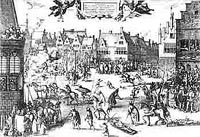
Every year on 5 November a failed conspiracy against the monarchy is remembered with fireworks and bonfires, even though the event took place 400 years ago. Why did the Gunpowder Plot take such a hold on the national memory?
By Alan Haynes
Last updated 2011-02-17
Every year on 5 November a failed conspiracy against the monarchy is remembered with fireworks and bonfires, even though the event took place 400 years ago. Why did the Gunpowder Plot take such a hold on the national memory?
To begin to understand the reasons why the Gunpowder Plot has reverberated so strongly down the years, it is necessary to look at the family history of an old and rich Catholic family, the Catesbys. It was the dynamic conspirator Robert Catesby who, along with Thomas Winter and John Wright, first devised the plot.
The intention of this vicious trio was to target King James, his wife Queen Anne, their son and heir Prince Henry, the privy councillors, nobility, clergy, judges and principal gentlemen of England - and blast them all to kingdom come during the ceremony of the State Opening of Parliament.
The intention of this vicious trio was to target King James...
The planned huge explosion would also have killed and maimed the many Londoners who would have gathered to view the event. Catesby, the mastermind and charismatic leader of the tight knit band of plotters, paid no attention to the mayhem his actions would have caused in the country at large, having been corrupted by hatred of Protestant rulers during the long reign of Queen Elizabeth I (who died in 1603).
Some of the wealth of the Catesbys had been squeezed from them by the fitful administration of anti-Catholic laws in Elizabethan England. Four years after serving the Queen as sheriff of Warwickshire, where he had inherited large land holdings, Sir William Catesby (father of Robert), and Sir Thomas Tresham, his brother-in-law, had stood trial for contempt in the Star Chamber.
The 'contempt' was their refusal to state on oath whether or not a Jesuit priest, Edmund Campion, had been illegally received in their homes. They were prominent figures in their communities, and so were treated to the exemplary punishment of a heavy fine for their refusal.
Between 1581 and 1605 Tresham was forced to pay £8,000 in penalties' about £4 million in today's values. Such fines may have been hurtful, but the men who paid them did not seek a violent end to the reign of Elizabeth I. They remained loyal to her, even though some of the younger generation fretted and frothed with rage.
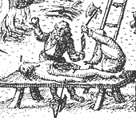 Detail from a print showing the execution of the gunpowder conspirators © The last physical threat to the elderly queen had occurred in 1601, due to a revolt led by her former favourite, the Protestant Earl of Essex. He was helped by the wayward Robert Catesby, who was wounded in the fighting, then captured, imprisoned and fined 4,000 marks (nearly £2,700). This was added to his other debts, which by 1598, when his father died, had reached a horrendous £12,000.
Robert only got out of prison with the help of his uncle, Thomas Throckmorton. No surprise, then, that in 1602 Catesby had to sell his beloved estate, Chasleton in Oxfordshire, to a wool merchant and lawyer, Walter Jones. The new owner paid Catesby £4,000, but he did nothing to evict him, as Catesby showed a deep reluctance to move on to lodge with his widowed mother at Ashby St Ledgers, just north of Daventry.
In essence what he was proposing was a massacre of the ruling class.
Catholics in England had hoped for some relief from their oppression, when James l of England and VI of Scotland acceeded to the throne, after the death of Elizabeth; his mother had, after all, been the devout Catholic Mary, Queen of Scots, executed in England in 1587 for her part in the Babington Plot.
King James had previously given indications of wanting to integrate Catholics into English public life; for example, he made Lord Henry Howard the Earl of Northampton, early in 1609. Even so, by then Robert Catesby had lost all patience with the new dynasty, which timidly allowed the weight of Protestant opinion in Parliament to gain the upper hand.
Unlike Edward Bushell, his second cousin and former friend of the executed Earl of Essex, who offered his services to the new monarch, Robert Catesby became instead an irreconcilable anti-Protestant.
Jesuits joined with these malcontents. They actively sought a Spanish invasion, and the gentleman pensioner Thomas Percy actually wanted to murder King James with his own hands, being sometimes close enough to attempt it. Given that James's wife, Queen Anne, had strong Catholic tendencies, the sense of outrage and betrayal felt by Catesby and his associates in considering her husband dissolved into despair when they reviewed the spiritual and political future.
Their deprivation under Elizabeth seemed to have become the inherited benchmark of Jacobean policy, and so the eloquent, handsome Catesby went far beyond the notion of assassinating the king. In essence he proposed a massacre of the ruling class, by blowing up the Houses of Parliament.
It was known that the child princess, Elizabeth, would not be there, but at her country home at Combe with Lord Harington. The conspirators believed they could seize her, and boldly imagined they could then use her to swing the country to them.
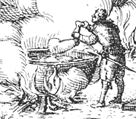 Detail from a print showing the execution of the gunpowder conspirators © Never mind that most of the nation would feel nothing but grief, horror and rage at the outcome of the proposed explosion, and that this torrent of distress might unleash a civil war of unequalled violence. This cluster of plotters, all known to each other through family or friendship, scarcely seemed to consider the shock waves that were likely to swamp the country if their plot succeeded.
Not every Catholic found Catesby irresistible. One family who were asked for peripheral help by the Jesuit Father John Gerard declined to cooperate. Gerard's request was for private lodgings in the house of a Mr and Mrs Fortescue, so that some persons who did not wish to be seen in his company could meet him unobserved.
The Fortescues lived in the Blackfriars Gatehouse in Puddle Dock Hill on the Thames, and when Gerard ventured the names of those who would visit, Mrs Fortescue alone (her husband was then absent) felt able to reject the request, since she regarded Catesby as a dangerous, unfettered playboy. With two beautiful daughters living in the house, perhaps her caution was merited.
After the collapse of the plot, the government, led by Robert Cecil, Earl of Salisbury, set about grubbing out for scrutiny the name of anyone linked in any way to the conspiracy. The captured Guy Fawkes resisted attempts to force the information out of him, and there was a fierce campaign to blame the Jesuits for it.
Father John Gerard went back in disguise to visit the Fortescues, presumably hoping they could cover for him in some way, and the master of the house, now returned, asked grimly 'Have you no one to ruin but me and my family?'
Have you no one to ruin but me and my family?
One of the government's agents, as information was being sought, was the playwright and poet Ben Jonson - who only weeks before had dined in public with the traitors. He, like Walter Jones, was desperately anxious to dissipate any hint of powder that lingered inadvertently about him.
The great figure of the court who was unluckily the most tainted by association with the plotters, was the most noble Henry Percy, ninth Earl of Northumberland. It was his secretary who had leased to the plotters the vault in Westminster where they stored their gunpowder. Luckily for him, when the Earl was eventually put on trial in the Star Chamber, the evidence against him did not lead to his execution, but to many years of imprisonment in the Tower of London.
The counties of the Midlands, through which many of the plotters had fled when the plot was discovered, were in an uproar as the culprits were hunted down, and dozens of suspects were arrested. Within a very few days Catesby and his cluster of plotters were besieged at Holbeach House, in Staffordshire, and were killed fighting. This left only a handful of men for trial and execution, along with the pitifully reduced Fawkes.
Although the Gunpowder Plot was a calamity averted, its after-effects were a real calamity for English Catholics, however loyal they might have been to the Crown. The Protestant nation's imagination reeled at the thought of the horror that had been averted, and for several hundred years Catholic families were corralled by legislation as well as by popular hatred.
Many publications reviled them, and many sermons preached against 'Romish practices'. King James and his family were for a time immensely popular, and when the youthful Prince Henry died suddenly in 1612 there was a huge outpouring of grief, and endless (rather overstated) testimony to his brilliance.
The innocent suffered long after the discovery of the grotesque plot in which they had played no part.
In these ways, and as the result of the actions of a mere handful of men, the taint of guilt was transmitted to succeeding generations. The innocent suffered long after the discovery of the grotesque plot in which they had played no part, and the notion of religious tolerance was alien to the country for generations.
The date 5 November became earmarked as a day to celebrate national salvation and the joyful repudiation of terrorism. Anti-Catholic sentiment among most people remained strong throughout the 17th century, and 'No Popery!' was a rallying cry even as late as the 1780 Gordon Riots - when the mob controlled the city for four days.
Until 1797 no Catholic male could vote in local elections, and until 1829 they could not vote in elections to Parliament - and this level of repression over such a long time inevitably led to an impoverishment of the whole kingdom. The gunpowder that did not explode, despite the earnest tending of Guy Fawkes, nevertheless managed to cause a severe, albeit invisible, national wound.
Alan Haynes is a freelance writer. He spent several years teaching History and English at University College, Cardiff, and did his post-graduate study at the Institute of Historical Research, London University, which led to the publication of The White Bear: Robert Dudley, Elizabethan Earl of Leicester (1987). He is also the author of Robert Cecil, 1st Earl of Salisbury: Servant of Two Sovereigns, and has contributed articles to History Today.



BBC © 2014The BBC is not responsible for the content of external sites. Read more.
This page is best viewed in an up-to-date web browser with style sheets (CSS) enabled. While you will be able to view the content of this page in your current browser, you will not be able to get the full visual experience. Please consider upgrading your browser software or enabling style sheets (CSS) if you are able to do so.

