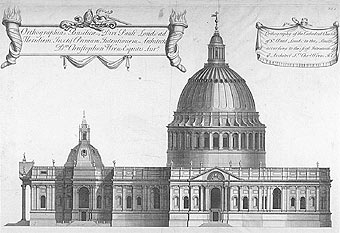
The Greek Cross Design
In the aftermath of the Great Fire of London, part of the ruins of Old St Paul's were patched up as a temporary cathedral. The structure, however, was in a very bad way, and in May 1668, following a fall of masonry, Wren was invited to submit proposals for a new cathedral.
Wren's earliest proposals envisaged rebuilding on the foundations of the old cathedral. In 1669 a wooden model was made of one such scheme. Known today as the 'First Model', the scheme was deemed too modest and quickly abandoned.
Christopher Wren began to think big. In c. 1670-72 he produced the 'Greek Cross' design. In the context of English cathedral design, this project, like its successor the 'Great Model', is remarkable for two reasons: it is in the classical style of the Italian Renaissance; and it is centrally planned, which is to say it has a main interior space set beneath a vast dome and subsidiary spaces located radially around the sides.
Inigo Jones's work at Old St Paul's had sanctioned the use of classical architecture in Anglican church design (most English churches were 'Romanesque' or 'Gothic'). But the clergy, who were used to cathedrals shaped like Old St Paul's objected to the centralised plan. Wren was forced to go back to the drawing board, a bitterly disappointed man.