
An intelligent and charming monarch or irresponsible risk-taker? Ronald Hutton unmasks the real Charles II.
By Professor Ronald Hutton
Last updated 2011-02-17
An intelligent and charming monarch or irresponsible risk-taker? Ronald Hutton unmasks the real Charles II.
Biographies of King Charles II show a curious discrepancy. Popular books, plays and films overwhelmingly portray a man of extraordinary charm, wit, courtesy and affability, loyal to old friends, perceptive and intelligent, and marvellously cultured; the monarch who introduced the British to champagne and yachting. This picture is true. Academic historians, by contrast, almost all see Charles as a king of no vision and no fixed ideals, irresponsible, unbusinesslike and with a disastrous taste for taking risks, who turned his three nations into states riven by chronic instability and distrust. This is also an accurate assessment. The difference is largely a matter of preoccupation.
The former image is largely that of the king in his leisure pursuits, while the latter is that of him as a ruler. What must be especially significant is that virtually all those contemporaries who have left opinions paid tribute to Charles's social charms, and none ranked him as a great monarch.
He certainly had one of the most traumatic, and potentially one of the most valuable, political educations that any sovereign has ever received.
...virtually all those contemporaries who have left opinions, paid tribute to Charles's social charms, yet none ranked him as a great monarch.
In 1642, when he was twelve years old, the three kingdoms of his father Charles I, England, Scotland, and Ireland, dissolved into civil war. His father was eventually imprisoned, and then executed in 1649. For eleven years young Charles was left to wander between a succession of refuges in the British Isles and on the Continent. Britain was ruled as a republic, and only the fact that its leaders quarrelled amongst themselves allowed a counter-revolution to occur in 1660, after which he was invited back to his thrones. These experiences have been credited with turning him into the cynical and opportunist politician that he became; but from his first actions as a king his enduring strengths and weaknesses are already apparent.
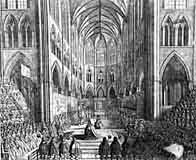 A print showing the coronation of Charles II © As is well known, in 1651 he attempted to avenge his father's death by invading England with an army of Scots, which was destroyed at the battle of Worcester. He escaped to safety in France by hiding in an oak tree and various other places between which he was spirited by loyal royalists. This romantic tale has become part of the national epic. What is less often appreciated is that his invasion of England was itself a crazy idea, provoked by the fact that he had just been defeated in Scotland by an English invasion force. In that situation most leaders would have fled to the Continent while it was still safe to do so, or withdrawn into the Highlands to wage guerrilla war.
...his invasion of England was itself a crazy idea
Instead Charles attempted the reckless gamble of slipping past his enemies into England in the vain hope that his English sympathisers would rise for him en masse. Instead he was chased, trapped, and overpowered, sealing the fate of his army by leading it in a suicidal charge uphill against superior numbers.
Almost all the 13,000 Scots who had followed him were killed or captured, and only amazing luck preserved the king. The bullets missed him and in his flight he stumbled upon a household of loyalists that were both willing and able to conceal him.
At his restoration, Charles faced a daunting set of problems, almost all concentrated in England. Scotland and Ireland were certainly both unhappy and divided realms, but the experience of republican rule had left them too exhausted and afraid of the English to take any initiative in British affairs or oppose the royal will. If Charles could only make a success of England, then his affairs were bound to prosper. One difficulty he faced was that initially he was given a financial settlement that was simply not adequate to his needs, and that Parliament did not take the problem seriously enough. As a result he had a serious shortfall of revenue. Another was that the civil wars had shattered the previous unity of the Church of England, leaving a huge spectrum of different beliefs and ambitions among Protestants that could not easily be reconciled.
If Charles could only make a success of England, then his affairs were bound to prosper.
The Restoration settlements made this situation considerably worse as, much against Charles's will, his Parliament decided on a narrowly defined Church based on hierarchy and ceremony, and expelled from it everybody who preferred a broader-based and more austere one, with a greater emphasis on preaching. This created a major new problem of nonconformity, as several new groups of Protestants formed alongside and outside the national one. The Parliament's answer was to try to persecute them out of existence, but their own courage and tenacity, and the negligence and good nature of local officials, meant that they survived. The government was therefore left with a mass of religious dissenters that could neither be wiped out nor reconciled to the Church. A third challenge for the restored monarchy was the obvious fact that it returned to a land in which old enmities still lingered among the former parties of the civil wars, and that care would have to be taken in the employment and management of royal ministers.
There remained two other problems. One was that the traditional balance of power in Europe was being overturned by an enormous growth in the strength of France, which as a neighbouring state represented a particularly obvious potential threat to England. France was also an intolerantly Catholic nation, in a period when Catholicism was making steady progress in taking over formerly Protestant areas of Europe. This threatened the national religion and identity, as well as the independence of the English, and focused suspicion on the small minority of Catholics who survived among them. These tensions focused upon the royal family when Charles, whose own fertility was abundantly displayed in the number of illegitimate children whom he sired, had the bad luck to marry a barren wife. She was a Portuguese princess, Catherine of Braganza, to whom the king had been lured by a rich dowry. Her inability to bear a child meant that the obvious heir to the throne was Charles only surviving brother, James, who proceeded to make a personal conversion to the Roman Catholic faith in 1673. This raised to acute levels the already simmering religious fears of his subjects, and in a sense created a crisis for the rest of Charles's reign.
The reason why his Parliament was initially unwilling to believe in the reality of his financial problems was the blatant extravagance of his personal lifestyle.
If Charles had only been able to adopt policies that consistently reassured the English of his determination to defend their traditional religion and liberties, and his basic soundness and responsibility as a leader, none of these difficulties need have caused as much trouble as they did. Instead he made every problem worse. The reason why his Parliament was initially unwilling to believe in the reality of his financial problems was the blatant extravagance of his personal lifestyle, supercharged by his obvious infidelity to his wife, which caused MPs to believe that public money was being wasted rather than falling short. Charles's response was to launch a completely unprovoked attack upon the Dutch in 1664 in the hope of winning plunder and prestige, claiming to his people that the Dutch were actually the aggressors. Instead the Dutch fought back, dragging him into a bloody and expensive war that ended in 1667 with the greatest naval humiliation in British history when the enemy surprised and burned the royal fleet in the dockyard at Chatham. Charles was forced to make peace at the cost of three colonial possessions, keeping only the single prize of New York. He was left with worse debts than ever and a furious Parliament.
In the end a rising economy swelled his income naturally to the point at which it became adequate after all, and he died the richest English monarch up till his time. As for the religious divisions, there is no doubt that he made them worse in turn by swinging until the end of his reign between encouraging persecution of dissenters and seeking toleration for them, according to what he perceived as his best interest at the moment. In the process he forfeited the trust and gratitude of all religious parties and postponed a resolution of the problem.
...he preferred to foster an illusion of his strength by making them feel weakened and insecure
In his employment and treatment of ministers, he began well by appointing men drawn from a wide range of former political backgrounds, and thereafter always chose able servants. He did not, however, manage them very well. Lacking the capacity to dominate and lead them personally, and to pursue clear and consensual policies, he preferred to foster an illusion of his strength by making them feel weakened and insecure. He encouraged them to compete with and undermine each other and left each in doubt as to the true extent of royal favour. Policy was made in secret, with different groups among his advisers, and the king's love of dissimulation and trickery meant that two separate and often incompatible policy initiatives were kept running at the same time, producing confusion, doubt, and sometimes disaster.
This was very clear in the field of foreign policy. When the growth of French power became obvious, in the late 1660s, Charles's obvious means of reassuring his subjects was to make an alliance with other Protestant nations, strong enough to be capable of containing France. This is exactly what he did, but he could not resist simultaneously opening secret talks with the French to secure himself with them as well. Instead they slowly lured him into agreeing to a plan to destroy the Dutch by launching another unprovoked attack upon them, this time with French help. Charles could not resist a gamble that promised wealth enough to set him free of financial worries at a blow and to restore his prestige as a war maker. When the attack was made, in 1672, the Dutch survived, and two years later an angry and suspicious Parliament forced the king to make peace.
For four years Charles struggled to regain public confidence, appointing new ministers to manage his money and the parliamentary sessions, and adopting a foreign policy which once again seemed to be bringing England into an alliance of powers determined to contain France. In 1678, however, he could not resist engaging in more secret talks with the French to deceive his Parliament and his prospective allies, and it was the discovery of this double-dealing that finally destroyed public faith in his government and made his brother's Catholicism seem unbearably menacing to many. The result was three years of political crisis, in which Charles eventually survived by keeping his nerve, hiring successive new ministers, offering concessions to divide his opponents, and avoiding any further rash adventures.
During his last three years of life, until 1685, he succeeded in winning the support of enough of the political nation to rule in safety; but the price was high. He had failed to work with Parliaments, and so dared not call any; which meant that England could not obtain war taxes and so was essentially paralysed in European affairs. Religious dissenters were once more savagely persecuted, and people who had opposed the king were purged from central and local government. The result might, in the long term, have been a stronger monarchy, but in the time allowed it produced a country that was weaker abroad and more bitterly divided at home.
Charles might be termed the 'Come-Back King' in more obvious senses than that of the restoration of his monarchy. Repeatedly, his ineptitude as a ruler drove his regime into trouble, and repeatedly his abilities were sufficient to drag it back from them, although it is arguable that national politics were left worse poisoned by hatred and doubt on each occasion.
He was, above all a master of disguises, and the greatest of all of these was the witty, sociable, good-humoured, easy-going individual which masked the reckless and unscrupulous politician that lay beneath. All who met Charles for a short time were utterly charmed. All those who knew him better served him with reservations. He treated public life like a masquerade; but politics and statecraft are a more serious business than that.
Professor Ronald Hutton, University of Bristol. Ronald Hutton took three degrees at Cambridge and Oxford, and was elected to an Oxford fellowship before moving to Bristol University where he is now Professor of History. His books include: The Triumph of the Moon: a history of modern pagan witchcraft (Oxford University Press, 1999) The Royalist War Effort (1981), Charles II (1989) and The Rise and Fall of Merry England (1994).




BBC © 2014The BBC is not responsible for the content of external sites. Read more.
This page is best viewed in an up-to-date web browser with style sheets (CSS) enabled. While you will be able to view the content of this page in your current browser, you will not be able to get the full visual experience. Please consider upgrading your browser software or enabling style sheets (CSS) if you are able to do so.

