
This is the story of how Britain celebrated Christmas during the war years. Discover why rationing made the Christmas dinner a triumph of ingenuity, and how Santa had to cobble presents together from discarded household bits and pieces.
By Mike Brown
Last updated 2011-02-17
This is the story of how Britain celebrated Christmas during the war years. Discover why rationing made the Christmas dinner a triumph of ingenuity, and how Santa had to cobble presents together from discarded household bits and pieces.
When World War Two broke out in September 1939, it was not uncommon in Britain to hear the remark, 'It'll all be over by Christmas!' - just as people had said that World War One would be over by Christmas 1914.
Unknown to people at the time, however, there would be five Christmases before May 1945, when this war was 'all over'. By that time the government's drive for maximum productivity had ensured that summer holidays were done away with, that Guy Fawkes' night had disappeared - the victim of blackout regulations - and that Easter eggs had disappeared, but at least the Christmas holiday still remained.
An excellent way, therefore, to study the home front in Britain during the war years is to take a look at how Christmas was celebrated during those years. It was celebrated all over Britain, in the towns and villages, on farms and in the cities, by rich and poor, old and young, so it can provide us with a series of varied annual snapshots, giving a picture of how conditions on the home front changed throughout the country, as the war progressed.
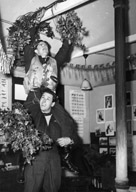
 23 December 1940; a family celebrate Christmas early, as the father is on duty on Christmas Day © For many, the first wartime Christmas was little different from how it had always been. There were a few extra restrictions, which affected some aspects of the seasonal festivities, but these were minimal - blackout regulations, for example, killed off the traditional sight of lit-up Christmas trees in people's front windows, and shop displays were obscured by anti-blast tape on the windows.
Food was not yet rationed, although in November 1939 the Minister of Food announced that butter and bacon were going to be rationed, starting in January. The government spent some time debating whether extra spending at Christmas should be discouraged; some maintained it was good for morale, but the Chancellor insisted that money should not be wasted. Few people took notice of these concerns in any case - with rationing coming, everyone was determined to enjoy the festive season, and hotels were fully booked, as were restaurants.
With rationing coming, everyone was determined to enjoy the festive season.
For many families, however, absence marked the traditional family get-together. Younger men might well be 'somewhere in France' with the British Expeditionary Force, and hundreds of thousands of city children had already been evacuated from their homes and sent to live in the country.
Throughout the last months of 1939 some of these evacuees had begun a gradual drift-back home, which was already a concern for the government. Families were discouraged from bringing their children back to the cities at Christmas time, in case too many were tempted to stay at home afterwards. Parties were laid on in many of the country areas where the children had been sent, to help them enjoy their stay; £15,000 (equivalent to about £500,000 today) was raised by various sources, such as newspapers, to entertain these visitors at Christmas.
Further-flung family members would also have found their journeys home difficult, as travel restrictions were beginning to bite; in September petrol rationing had been introduced, and rail travel was discouraged.
For most people, however, this was a happy time, and people spent freely on presents. Many gifts were topical; for children, miniature Red Cross, RAF or naval uniforms were popular. The usual card games - which that year included 'Blackout', and 'Vacuation' - were also available, as were many 'annual' books, including the Blackout Book.
For adults, topical gifts included steel or Bakelite helmets, and gas mask cases in Rexine or leather. People were encouraged to buy French food and drink, and as a result many troops in France, especially officers, received parcels from home that included French produce.
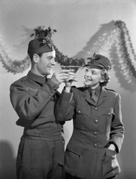 British Army private and a women from the Auxiliary Fire service drink a toast during Christmas dinner © This was the first real wartime Christmas. In the previous year western Europe had fallen to Hitler's forces, and thousands of British servicemen had been killed, wounded, or captured. In September the Blitz on London had started; in November the devastating raid on Coventry had taken place. December targets of the Luftwaffe had also included Birmingham, Southampton, Bristol, Manchester, Sheffield, Portsmouth, Gosport and Leicester. The nation had survived the Battle of Britain, and the expected German invasion of these islands had not materialised, but Britain was still under siege. There was a break in the bombing over the Christmas holiday, but everyone was aware that this was only a brief respite.
For Christmas, practical gifts were in vogue - gardening tools, books, bottling jars, seeds.
This was also the first Christmas 'on the ration', with food rationing having been a part of everyday life for almost a year. By this time weekly rations were four ounces of bacon and/or ham, six ounces of butter and/or margerine, two ounces of tea, eight ounces of sugar, two ounces of cooking fats and meat to the value of 1/10d (9p), although in the week before Christmas, the tea ration was doubled and the sugar ration increased to twelve ounces.
There was still plenty of non-rationed food available, however - at a price. Wines and spirits were plentiful, but French goods were almost completely gone, and imported fruit was extremely expensive. For Christmas, practical gifts were in vogue - gardening tools, books, bottling jars, seeds. Some gardening magazines even recommended a bag of fertilizer as a gift, and the most popular present for Christmas 1940 was soap.
The usual seasonal football matches took place that year, although many players were in the forces, and transport problems meant long-distance fixtures were a problem. So the pre-war league was replaced by a regional structure, while scratch teams were the order of the day. Two famous football players, Tommy Lawton and Ken Shackleton, both played for two different teams on Christmas Day 1940 - Everton and Tranmere, and Bradford and Bradford City respectively. Brighton and Hove Albion, away to Norwich, could only muster five players, and their team was supplemented by Norwich reserves and supporters. Unsurprisingly Norwich won 18-0.
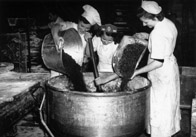 24 September 1941, NAAFI chefs start to prepare their plum puddings for Christmas © Clothing and textiles were rationed from June 1941. By Christmas, rationing was at its height; 3 ounces of cheese, 4 ounces of jam or preserves (including mincemeat), 2 pints of milk, and about 3 eggs a month were added to the list of weekly rationed foods. From the beginning of December, everyone received a monthly allocation of 16 points for various goods covered by the system. One month's points could get you, for instance, 1 pound of luncheon meat or 1 1/2 pounds of canned salmon.
Wrapping paper was very scarce ... while toys, if they could be found, were often shoddy or very expensive.
Petrol and manpower shortages meant that shops no longer delivered goods to customers' homes, so people had to carry all their purchases. Wrapping paper was very scarce. There were neither turkeys, nor gin, sherry, chocolates or fruit; cigarettes, cigars and tobacco were in short supply, while toys, if they could be found, were often shoddy or very expensive. In Hamley's, even the smallest teddy bears cost 15/6 (77p) - a lot of money in those days.
People made or renovated presents, and magazines in the lead-up to December were full of ideas for home-made gifts. One patriotic gift was a National Savings Certificate, another a savings book with a few stamps attached.
Yet Christmas 1941 was a time of optimism; Britain was no longer alone in the fight against Hitler. In June Germany had attacked Russia, diverting the Luftwaffe eastwards and away from Britain. Earlier that month, the USA had entered the war, after the Japanese attack on Pearl Harbor. In the public view there was now no doubt that the Allied forces would eventually win, despite the undoubted prospect of set-backs - and indeed, on Christmas Day, Hong Kong surrendered to the advancing Japanese, although the news was held back from the public.
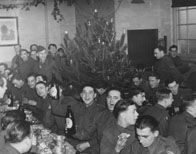 Belgian troops celebrate the Christmas of 1940 in exile © Two gifts popular at Christmas had by this time been added to the list of rationed goods; domestic soap was added in February 1942 (either 4 ounces of household soap or 2 ounces of toilet soap were allowed per month), and sweets in July (12 ounces a month). Shortages were the order of the day; alcohol was difficult to get unless you were a regular at the pub or off-licence. To prepare for Christmas people had started to save their points coupons, or items of food, months beforehand.
People made their own Christmas decorations, or cut pieces of holly, shrub, or any available greenery and decorated them with pinecones or whitewash. The Ministry of Food suggested:
'A Christmassy sparkle is easy to add to sprigs of holly or evergreen for use on puddings. Dip your greenery in a strong solution of Epsom salts. When dry it will be beautifully frosted.'
Another Ministry comment was that, although there were:
'... no gay bowls of fruit, vegetables have such jolly colours. The cheerful glow of carrots, the rich crimson of beetroot, the emerald of parsley - it looks as delightful as it tastes.'
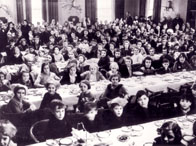 Children enjoy a Christmas dinner in Worthing © Shortages were at their height; Vere Hodgson wrote for the social research organisation, Mass Observation.
'We are pretty well on our beam ends as far as Christmas fare is concerned. No chance of turkey, chicken or goose - not even the despised rabbit. If we can get a little mutton that is the best we can hope for. A few Christmas puddings are about. There are shops with three puddings and 800 registered customers.'
The Ministry of Food estimated that only one family in ten would get turkey or goose for their Christmas dinner that year. A lot of Christmas food was 'mock' (ie fake). Christmas recipes included mock 'goose', 'turkey' (made from lamb), 'cream' and 'marzipan'.
Once again presents were 'make do and mend'. Magazines printed instructions for embroidered bookmarks and calendars, knitted slippers and gloves, and brooches made from scraps of wool, felt, plastic, or even old silver cutlery.
This was probably the most joyless Christmas of the war. After the Allied Normandy invasion in June, and the rapid advance of Allied forces through France, people had hoped once more that it might be 'all over by Christmas'. But the news from Europe was of death and destruction, despite Allied successes, and in mid-December the Germans had launched the Ardennes Offensive, in which many thousands of combatants had died on both sides.
... people had hoped once more that it might be 'all over by Christmas'.
In June 1944, the German air attack - this time with V1s and V2s - had resumed, then on Christmas Eve that year, 30 'doodlebugs' hit England - from Derby up to County Durham. Despite these horrors, however, the threat from conventional aircraft was virtually past, and with it the need for the blackout. As a result, that Christmas the churches were allowed to light their stained-glass windows for the first time for four years.
The Ministry of Food announced Christmas treats - an extra 1 1/2 pounds of sugar, 8 pennyworth (3.5p) of meat, and half a pound of sweets. Once again there was a rash of do-it-yourself gift articles in magazines and books. Woman magazine for 9 December advised: 'One of the nicest presents to give (or to receive) is a half-pound of home-made sweets', and the book Rag-Bag Toys had instructions for making gifts such as a 'Chubby pink pig from an old vest', or a doll made from 'old stockings'.
Alcohol was at its scarcest that Christmas; one indicator showing this is the fact that, of the half million inhabitants of Kensington, Hammersmith, Fulham and Chelsea, in London, only one woman was arrested that year for drunkenness over the holiday.
It was no wonder that people longed for the war to be over, and no surprise that when victory in Europe was at last announced, on 8 May 1945, euphoria and wild rejoicing swept through the land.
Books
A Wartime Christmas by Andrew Hubert, Maria Hubert (Sutton, 1995)
War Games by Tony McCarthy (Queen Anne Press, 1989)
We'll Eat Again by Maguerite Patten (Hamlyn, 1990)
Wartime Women by Dorothy Sheridan (Phoenix Press, 2000)
The Phoney War on the Home Front by ES Turner (Michael Joseph, 1961)
Put that Light Out; A Child's War; Evacuees - all by Mike Brown (Sutton; 1999, 2000, 2000)
The Wartime House by Mike Brown (with Carol Harris) (Sutton, 2000)
Mike Brown is an authority on Home Front Britain during the Second World War. A history teacher, he is the author of four books looking at aspects of the Home Front in World war Two -- Put That Light Out (about civil defence), A Child's War, Evacuees and The Wartime House (with his wife, Carol Harris). He was a consultant on the Timewatch programme 'Christmas Under Fire'.



BBC © 2014The BBC is not responsible for the content of external sites. Read more.
This page is best viewed in an up-to-date web browser with style sheets (CSS) enabled. While you will be able to view the content of this page in your current browser, you will not be able to get the full visual experience. Please consider upgrading your browser software or enabling style sheets (CSS) if you are able to do so.

