
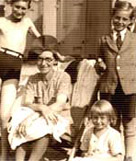
The evacuation of children from cities to the countryside during World War Two was traumatic for many of them. David Garmston tells the stories of some of those sent away from their families to live with strangers.
By David Garmston
Last updated 2011-02-17
The evacuation of children from cities to the countryside during World War Two was traumatic for many of them. David Garmston tells the stories of some of those sent away from their families to live with strangers.
Ray Chaffey's father kissed him goodbye and gave him his final instructions. No matter what happened he must look after his little sister and not be separated from her. Sixty years on from that emotional parting at a railway station in Bristol, Ray has been remembering the war when he was sent away as an evacuee. He was only eight years old and did not want to go. He would rather the family stayed together, even died together, than face a future with strangers.
Ray and his sister joined hundreds on the train that was taking them into the safety of the countryside. He remembers they were both wearing new Burberry raincoats. At Ilfracombe, they were taken to a hall and the locals arrived to pick which children would stay with them. 'I was hoping that a nice looking lady walking through the hall would chose us but she walked right past. Soon there were children getting up from the floor and walking off with complete strangers.'
The room steadily emptied while Ray and his sister patiently waited for someone to take them. Eventually a woman announced that she would take the little blonde girl.
You'll have to take both of us.
However, Ray knew his duty. I stood up and said to her: 'You'll have to take both of us.' The woman told him not to be silly. However, Ray insisted and held onto his sister for grim death. Finally the woman gave up.
Later that afternoon, a 13 year old girl picked them out and took them home to a two up two down cottage occupied by a married couple and their five children. The exhausted evacuees shared beds with the other brothers and sisters. They were safe, but far from home and far from happy.
Ray Chaffey is now 68 but the memories of those war time years are as sharp as ever. It is clear that thousands of children who were evacuated in the war are still living with the psychological consequences of a traumatic parting.
At the start of the war, Bristol had been regarded as relatively safe. However the blitz began in earnest on the night of 24 November 1940 ,when the Luftwaffe attacked targets across the city. The damage was dreadful. The enemy rained down explosives and incendiary bombs and then dumped barrels of oil onto the flames. The inferno could be seen for 40 miles, and the medieval city centre was destroyed.
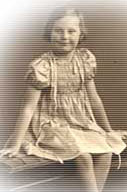 Bristol evacuee Christine Marsh © Two months earlier, there had been a daytime raid on the aircraft works on the outskirts of Bristol. The factory was near the large new public housing estates in Filton and Horfield. They were home to thousands of children and they were effectively in the front line.
In those days, there was no talk of 'smart bombs' and 'collateral damage'. The only way to avoid seeing children killed was to move them. Other cities had already evacuated youngsters to safety, and now it was decided that Bristol was also no place for children.
The plans were put into action. Speed, safety and efficiency were the requirements. Perhaps, the nightly explosions of falling bombs had de-sensitised the authorities about the feelings of children. Everybody believed that they were working in the children's best interests but many of the children thought that they were being abandoned.
It seems incredible now that four-year-olds were sent off to stay with strangers - for what could be years at a time. The trauma has never been properly assessed, but it is now becoming clear that some of those young lives were seriously blighted.
... many of the children thought they were being abandoned.
A reunion was recently held for those who had been evacuated from Bristol, and was attended by a few dozen people. The event was aired on local BBC television, and the dam of emotion burst. Dozens wrote in recounting their experiences. Often the letters ran to 20 or more pages, as people poured out their hearts about events that had happened some 60 years ago.
Old soldiers have told their stories. Fighter pilots and sailors and infantrymen have been filmed and written about. World War Two has been better documented than any other conflict in history, but the children's story has been largely missed. Some adults have kept their emotions locked away for decades.
Rita Cryers, for instance, has just told her family what happened, after 60 years of silence. 'I pushed it right to the back of my mind and let everything else take over. I have never talked about it'. Rita is now in her late sixties but as a shy little girl, she was sent to the Forest of Dean. It is an event that still haunts her. Recently she returned to the village of Bream, where she was evacuated with her brother, Brian.
Rita stopped at the house where she was billeted. 'I must have been traumatised. I feel very upset because when I saw it for the first time I was a very small child and it seemed so threatening and scary. I felt cold and very lonely.' Rita feels better now she has been back to lay to rest some of those old ghosts.
But she is by no means alone in having been affected all her life. Betty Taylor went to the same village. 'I just feel it was not good for me, and I think the reason I get panic attacks is due to being evacuated. The family I stayed with were warm and kind, but I would never have sent my children away'.
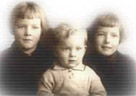 Joy, June and David Worgan - Bristol evacuees © The children from the city not only had to cope with a new family but a different culture. For these city children, the way of life in the countryside seemed primitive. Betty Taylor remembers going into her new home for the first time:
'Having come from a modern house it was like going back in time. The toilet was halfway up the garden. There was no running water. The house was sunless. I was just so homesick, you can't describe that feeling. Mum kept saying to us that she didn't send us away because she did not want us. But each time she came to visit it got worse because I thought she was going to take us home and she didn't.'
Of course, some children fared better than others. Some talk of rosy cheeks and country air, and fresh food and plump eiderdowns and lifelong friends. They were the fortunate ones, who swapped a loving home for loving foster parents.
Having come from a modern house it was like going back in time ...
June Fryer had a contrasting experience when she was evacuated from Bristol with her two sisters to Cornwall. Her elder sister Margaret was separated from them, but she stuck with 7-year-old Gladys:
'Eventually, we were taken by a childless couple. It turned out they were the harbourmaster and his wife. They had a luxurious bungalow overlooking the harbour. When we got there they bathed us and we had a huge bedroom, just for the two of us.
To us it was pure luxury because when we were at home we had to be five in one bedroom. When we got up, we had two boiled eggs with soldiers for our breakfast.'
However, those happy days were short lived. A mine killed the harbourmaster and his wife when they were out on a boat. The girls had to be rehoused, and were split up. The older sister, Margaret, was so unhappy that she ran away.
Their father was alerted and he came and took them all home to take their chances in the Blitz. Many others drifted back to Bristol, which remained a key target, in the early part of the war, because of the railways, the docks and, crucially, the aircraft factories.
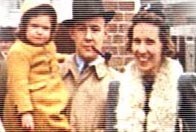 Filton evacuees and their families © Somehow the locals lived with the bombs, encouraged by a visit by the King and the Prime Minister. Friends in the United States, who had heard of the terrible bombing, sent food, clothing and money. Tony Hills remembers the sunny day of 25 September 1940, which was to seal his fate for the duration of the war.
He was catching bees in a jam jar when the German bombers appeared over his Bristol home, and his mother grabbed him and ran to the Anderson shelter. 'I was to learn that 57 Heinkell bombers dropped 100 tons of bombs in 15 seconds on Filton Aerodrome, killing 60 workers when the works shelters received a direct hit.'
His mother decided that he must go, and he left the city on 19 February 1941. 'There were lots of squeezes and tears running down mother's cheeks.'
Tony went to Clovelly and was well looked after but never felt loved. He returned to Bristol in the October of 1942, at the age of eight, when the worst of the Blitz was over. It was as middle age approached that the flashbacks started. 'Sometime after I reached the age of 40 I started to have regular dreams about the farm where I stayed. So real, it was as if I was still there.'
Ten years ago he went back to Clovelly, to be reunited with the family he had stayed with. It helped him to come to terms with what had happened to him. Until then he had only been able to write about his experiences.
There were lots of squeezes and tears running down mother's cheeks.
He bashed out his thoughts on an old typewriter. Page after page of memories and feelings rushed out. It was a healing experience, and Tony is anxious to help others who have been tormented by the separation from their families. He has organised the reunions and now there is talk of a support group so that the feelings that have been pent up for a lifetime can be released.
However, Tony is also sympathetic to many of the host families who took them in. 'It must have been a very trying time for the local people in whose homes we were thrust. It must be realised that in those war years everybody had to experience some discomfort. I think our discomfort was little compared to some children in the war, some of whom never survived.' By the time the conflict ended in 1945, all the children went home, as Bristol and the rest of the country celebrated.
Until their evacuation, most of the youngsters had not travelled more than a few miles. Now they returned and some were wise beyond their years. The evacuation of thousands of children from cities all over the country is unique in British history. Over 60 years on, it is worth remembering their part in the war and their share of the suffering.
Kirkby Malzeard during World War Two: Site detailing the effect of the war on an English village
School site: Site on the Home Front during World War Two
David Garmston is a journalist in the west country. He works as a presenter for the BBC regional news programme 'Points West', and presented the documentary programme described in this article about wartime evacuees.



BBC © 2014The BBC is not responsible for the content of external sites. Read more.
This page is best viewed in an up-to-date web browser with style sheets (CSS) enabled. While you will be able to view the content of this page in your current browser, you will not be able to get the full visual experience. Please consider upgrading your browser software or enabling style sheets (CSS) if you are able to do so.

