
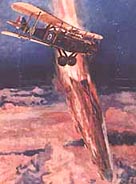
Even with the French threat removed, Britain could not relax. Germany was now seen as the next invader and had new technologies under development. Dan Cruickshank explores the renewed potential for invasion at the end of the 19th century.
By Dan Cruickshank
Last updated 2011-03-10
Even with the French threat removed, Britain could not relax. Germany was now seen as the next invader and had new technologies under development. Dan Cruickshank explores the renewed potential for invasion at the end of the 19th century.
Prussia's shattering defeat of France in 1870 did not mean the end of invasion fear in Britain. As the traditional enemy against which massive new defences had been constructed during the 1860s, France had been removed as a threat but the manner of its removal caused new fears. Revealed as efficient, militaristic, ruthless and ambitious for world power and territory, Germany was now seen by Britain as the potential new enemy - the next invader. This new fear was expressed in an unusual form as the polemical invasion novel and the (usually jingoistic) popular magazine or newspaper.
Germany was now seen by Britain as the potential new enemy - the next invader.
The first of these alarmist articles, which appeared initially in Blackwood's Edinburgh Magazine and then in sixpenny-book form, was the Battle of Dorking. Published in 1871 and written by George Chesney, it described vividly the way in which a German invasion would affect ordinary households and argued that Britain was, due to its complacency and reductions on military spending, vulnerable to attack from Germany.
The non-arrival of the Germans on Britain's shores during the 1870s did not cool the fevered imaginations of the alarmist novelists. The next target for invasion terror was the proposed Channel Tunnel; in 1882 a scheme to build a railway tunnel from Calais to Dover was proposed in Parliament. The titles of the novels this scheme provoked - England in Danger, The Seizure of the Channel Tunnel, The Battle of the Channel Tunnel - reveal the popular concerns that were shared by Queen Victoria, who called the tunnel 'objectionable', and by Lord Randolph Churchill who probably summed up public opinion when he observed that 'the reputation of England has hitherto depended on her being, as it were, Virgo intacta'.
Objections from all levels of society stopped the project after a couple of miles of tunnel had been excavated from each coast, but no sooner had this 'threat' been stymied than another appeared. As if to underline the almost manic nature of Britain's late 19th century invasion fear, France, so suddenly thrashed by the Prussia, made a sudden reappearance in the mid 1880s as enemy number one. What if, wondered some more pessimistic military analyst, France and Russia joined forces to invade England to strike with terrifying ease at the very heart of the British Empire - London. The capital's defences were outmoded and organised primarily for the defence of its dockyards at Tilbury and Chatham while the regular army was small and scattered over much of the world policing the empire.
The capital's defences were outmoded and organised primarily for the defence of its dockyards at Tilbury and Chatham...
A flurry of learned and sensational articles and anxious debates in Parliament stirred up great public and political concern. Typical was a little book, published anonymously in 1885 and entitled The Siege of London. It envisaged a French invasion that culminated in a tremendous battle in Hyde Park, the capitulation of London and the eventual loss of India, the Cape, Gibraltar and Ireland.
The consequences in Britain of this new fear of France was an increase in the size and improvement in training and equipment of Britain's volunteer forces, and the construction, to the southeast of London, of a ring of fortified mobilisation centres, notably at Box Hill and Henley Grove near Guildford. These centres were to act as supply depots and as rallying points around which local volunteers could muster and from which they could draw arms and ammunition.
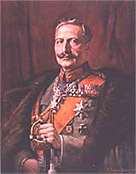 Wilhelm II, German ruler, 1888 - 1918 © With the signing of the Entente Cordiale between France and Great Britain the fear of French invasion was finally and formally laid to rest in 1904. Attention was now firmly focused on Germany as the future foe and it was at this moment that Britain's most famous invasion novel was published. The Riddle of the Sands, written by Erskine Childers and published in 1903, focuses on a cunning German invasion plot with troops sneaking across the North Sea hidden in fleets of coal barges. Although the technique by which Childers envisaged a German invasion was novel, the essential method of attack - a sea-borne onslaught - was entirely traditional. This is hardly surprising since, around 1900, an arms race between Britain and German was in full swing and the focus of this competition was the battleship.
An overseas empire was needed, argued Germans, not only for prestige but because the German economy would atrophy if it did not acquire colonies...
The German bid to become a world power with its own far-flung empire was very much the personal ambition of the young Kaiser Wilhelm II who came to power in 1888. An overseas empire was needed, argued Germans, not only for prestige but because the German economy would atrophy if it did not acquire colonies that could provide raw materials and markets for finished products. To acquire, service and protect these colonies a strong German naval and merchant fleet was essential, but the construction of a powerful fleet of warships, making Germany into a significant maritime power, brought it into direct conflict with Britain. Since the Battle of Trafalgar in 1805 Britain's Royal Navy had been the dominant fighting fleet in the world; now Germany was challenging this position.
In 1898 and 1900 Germany passed Navy Laws which identified the types and numbers of warships required and which provided permission and cash for the project. To justify the vast expense of the undertaking, these laws also identified a specific and dangerous enemy that this fleet was being built to counter: 'For Germany, the most dangerous naval enemy at the present time is England.... Our fleet must be constructed so that it can unfold its greatest military potential between Heliogoland and the Thames....' As the construction of a massive fleet was being debated and agreed by the Kaiser and his military and political advisors another undertaking, of great relevance to future German naval strategy, was being completed. The Kiel Canal, which opened in 1895, provided the German navy with a fast connection between the Baltic and the North Sea and so allowed its different fleets to work in close co-operation.
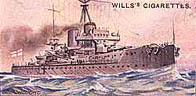 The British battleship, completed in less than a year: at that time a record in ship construction © Britain's response to the spectacle of Germany providing itself with the will, the motif and the means for launching an invasion was to reinforce its first and best line of defence - the Royal Navy. Despite its prestige and perceived power the Royal Navy was, in the late 19th century, outdated, disorganised and unready for war with a major world power. The First Lord of the Admiralty John Arbuthnot Fisher recognised the alarming truth and when he came to power in 1904 he initiated reforms and promoted the construction of a revolutionary battleship HMS Dreadnought. Designed and launched with astonishing speed the first dreadnought appeared in 1906 and was the world's first all-big-gun battleship. At a stroke these ships of the dreadnought class made all existing battleships - ironically including those possessed by the Royal Navy - redundant and redefined the way in which major naval engagements of the future would be fought.
At a stroke these ships of the dreadnought class made all existing battleships - ironically including those possessed by the Royal Navy - redundant...
The Kaiser recognised HMS Dreadnought as the 'armament of the future' and the German navy joined Britain in the race to create a new navy organised around this powerful new type of battleship. It seemed that the outbreak of war between Britain and Germany was inevitable; it was only a question of when. In 1906 Fisher predicted August 1914, basing his calculation on the completion of the widening of the Kiel Canal, necessary to accommodate the new generation of big battleships.
In the decade before the start of World War One it would have been reasonable to assume that the outcome would be decided at sea through the clash of the revolutionary dreadnought class of battleships. In fact this was not the case. The one clash, the Battle of Jutland of May 1916, was an inconclusive affair (the Royal Navy suffered more damage but the German fleet did not dare to venture on the high seas again) and the threat of a sea-borne German invasion of Britain never materialised. But Britain was invaded, and this invasion came from a new direction - the sky.
This first war of the new century heralded a new kind of terror - a new kind of invasion. Attack came not from enemy soldiers but from enemy aerial bombs. For the first time the civilian population throughout Britain and not just those in exposed coastal locations were vulnerable to attack. It was not Britain's soldiers who were to suffer direct enemy attack but also Britain's civilians. The frontline encroached onto the very doorstep of the embattled population.
The first German air attack against Britain took place on the 21st December 1914. This one against Dover was delivered by an aeroplane, but the major form of attack was to be Germany's futuristic and potentially war-winning super-weapon, the zeppelin.
Although dismissed by Winston Churchill before the war as 'enormous bladders of combustible and explosive gas' the zeppelins proved very hard to attack.
The first zeppelin, a rigid-framed airship designed and fanatically promoted by Count Zeppelin, flew in 1900. By 1914 the German army and the navy had started the build up of fleets of airships. With the first airship raid against England on the 19th January 1915, targeting East Anglia and killing 20 people, 20th century warfare had arrived.
Although dismissed by Winston Churchill before the war as 'enormous bladders of combustible and explosive gas' the zeppelins proved very hard to attack. They slipped over the British coast silently and at great height so they were difficult to reach with conventional weapons. They dropped their bombs on utterly unsuspecting targets and then melted away. They were, it appeared, the ultimate terror weapon. But the Germans wanted the zeppelin to do more than create terror by the arbitrary scattering of bombs; they wanted it to realise its potential as a war-winning weapon by operating as a strategic bombing force attacking and destroying specific and important targets. This the zeppelin could not do. It was vulnerable to the winds and so often difficult to fly and virtually impossible to steer with any degree of accuracy.
Zeppelin design was improved and on the night of the 23rd September 1916 three of the new, large super-zeppelins took off to raid Britain. Within the next few hours two of these promising new craft - the L 32 and the L 33 - were destroyed by the British. By late 1916 the zeppelin force had finally been defeated. British defences had been greatly improved so that intruders were more rapidly located and more often attacked by both anti-aircraft guns and fighters. Fighters, of more powerful design and armed with new explosive and incendiary ammunition were to prove the great enemy of Churchill's lumbering 'gaseous monsters'.
Effectively, the zeppelin threat was over, but attack from the sky was not. Germany continued to believe that air raids against Britain were a potentially war-winning exercise and from May 1917 the task was given over to aircraft. As weapons the Gotha and Giant bombers - flying in formation, undisturbed by wind and initially raiding by daylight - were more deadly and accurate than airships had ever been. The death toll and damage they inflicted in Britain's cities was horrifying. On one raid on London and Kent on the 13th June 1917 162 people were killed and 432 injured, including 18 children killed and 45 injured in an East End school.
...attacks like this achieved little in Britain beyond death and fury in the civilian population.
But attacks like this achieved little in Britain beyond death and fury in the civilian population. Military targets of significance were not greatly damaged and public morale did not crack. When the armistice was agreed in November 1918 the power of air invasion remained unclear. It had achieved little of direct military value but it had killed many, caused horrendous damage in city centres and created terror. If planes were bigger and able to carry heavier bomb loads, and if accuracy of attack could be achieved and defence from fighters improved, then the potential of a bomber force as an independent weapon of war, executing strategic attacks on the heartland of the enemy, would finally be realised.
It was this thinking that influenced military planning during the inter-war years with Britain in particular embracing the destructive potential of strategic bombing undertaken by long-range, well-armed heavy bombers. Politicians and military planners argued aerial offense was the most effective against foreign aggression or invasion.
This acceptance in Britain that the heavy bomber would prove virtually invulnerable led to the creation, from 1935, of a heavy bomber force. The Vickers Wellington came into service in 1936 in which year the Government aimed to give the RAF a bomber force of 1,736 by May 1939. But, when war came in 1939, it was Britain that was, initially at least, to be the testing ground for new methods of aerial attack.
Books
Twentieth Century Defences in Britain: an introductory guide by I. Brown et al (Council for British Archaeology, 1995)
Fire over England: The German air raids in World War I by H.G. Castle (Secker & Warburg, 1982)
The World Crisis 1911-1918 by W.S. Churchill (2 vols. Odhams Press, 1939)
The Defenders: A history of the British volunteers by G.Cousins (Muller, 1968)
Dreadnought by R.K. Massie (Pimlico, 1993)
Invasion: From the Armada to Hitler, 1588-1945 by F.McLynn (Routledge and Keegan Paul, 1987)
Zeppelins Over England by K.E. Poolman (Evans Bros., 1960)
Journal of Maritime Research, National Maritime Museum An interesting resource on a wide range of maritime subjects, historic and current. The JMR site is part of the Greenwich National Maritime Museum site.
Imperial War Museum offers unique coverage of conflicts, especially those involving Britain and the Commonwealth, from World War One to the present day.
Dan Cruickshank is one of the country's leading architectural and historic building experts and a regular presenter on the BBC. He is an active member of the Georgian Group and the Architectural Panel of the National Trust and director of the Spitalfields Historic Buildings Trust. Dan is a frequent contributor to The Architects' Journal and The Architectural Review and is author of Life in The Georgian City and The Guide to the Georgian Buildings of Britain and Ireland.




BBC © 2014The BBC is not responsible for the content of external sites. Read more.
This page is best viewed in an up-to-date web browser with style sheets (CSS) enabled. While you will be able to view the content of this page in your current browser, you will not be able to get the full visual experience. Please consider upgrading your browser software or enabling style sheets (CSS) if you are able to do so.

