Victoria's dynasty
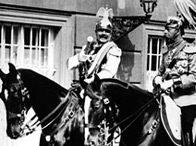 Kaiser Wilhelm II and George V at Potsdam, 1913 © With self-preservation being one of the chief motivations of monarchy, by 1910 Europe's sovereigns, or at least their advisers, had had the foresight to adapt themselves to the more liberal tenor of the times. The French Revolution, a century before, had taught them a lesson. Because the burgeoning middle classes had demanded legal constitutions, the monarchs had granted them. Where there had been a clamour for extended suffrage, they had agreed to it. By assimilating new ideas, monarchies had to some extent converted themselves into symbols of democracy; the leaders of these same monarchies, however, remained stubbornly blind to the gradually spreading republican and revolutionary movements taking root in their countries.
Rendering them unassailable (or so they fondly imagined) was the fact that the monarchs of Europe were all closely related. Queen Victoria was sometimes called the Grandmamma of Europe, and there was hardly a Continental court that did not boast at least one of her relations. During World War One there were no less than seven of the old Queen's direct descendants, and two more of her Coburg relations, on European thrones. Before it happened, can anyone blame this family of kings, or their subjects, for assuming that a war between these crowned cousins was all but impossible?
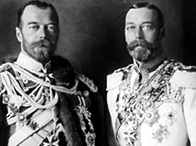
One can appreciate why Kaiser Wilhelm II, at the outbreak of war in 1914, exclaimed that 'Nicky' had 'played him false'. For the rulers of the world's three greatest nations - King George V of Great Britain and Tsar Nicholas II of Russia on the one hand, and the German Kaiser on the other - were not simply cousins, they were first cousins. If their grandmother Queen Victoria had still been alive, said the Kaiser, she would never have allowed them to go to war with each other.
Instead, World War One proved once and for all that the family ties between the reigning houses of Europe were more or less irrelevant. Their kinship simply snapped, like cotton threads, as the storm of war broke over their heads.