William Beckford
Slave plantation owner, lord mayor, politician
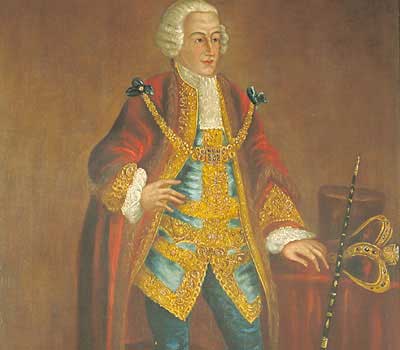
William Beckford was born in Jamaica, the son of a leading sugar plantation owner who, at his death in 1735, was the wealthiest and most powerful man on the island. William Beckford's own property in Jamaica eventually included 22,000 acres of sugar plantations and approximately 3,000 slaves. In the mid-1740s Beckford moved to London to run his business affairs and he became one of the most powerful businessmen in the city. He was twice lord mayor of London and was known for the lavish public banquets he laid on.
Beckford's wealth further increased as a consequence of the Seven Years War (1756-1763) with France. This disrupted French sugar supplies and lead to a massive increase in the profits made by British plantation owners. Beckford's profits were invested in enterprises such as shipping and money lending. He was also aware that political influence would help his business affairs. In 1747, he was elected an MP, first for Shaftesbury and then for London and was a friend and supporter of William Pitt the Elder who became secretary of state and later prime minister. He led an influential group of MPs who were all absentee planters from the West Indies and formed a powerful pro-slavery lobby.
The lobby influenced government policy on defence, trade, shipping and finance, but Beckford also supported Pitt's political reform, including the extension of the franchise. The absentee planters were criticised for their use of slaves and their conspicuous consumption, their manipulation of the sugar market and their use of wealth to gain political influence. There was also social hostility from the established aristocracy towards Beckford and other rich planters, who regarded them as nouveaux riches. In 1756, Beckford married into 'old money'. His wife, Maria Hamilton, was the daughter of the Honorable George Hamilton and the granddaughter of an earl.
In about 1736, Beckford bought the Fonthill estate in Wiltshire where he built a large and expensive house and then entertained on a lavish scale. His only legitimate son, also called William (1760-1844), was for a time the wealthiest man in the country. He also acquired a large collection of art, and built Fonthill Abbey.