Black Santa
After World War Two, a broad movement against racist institutions and stereotypes developed in many Western societies. Civil rights organisations in the United States protested against negative stereotypes of African-Americans and against institutional racism and discrimination.
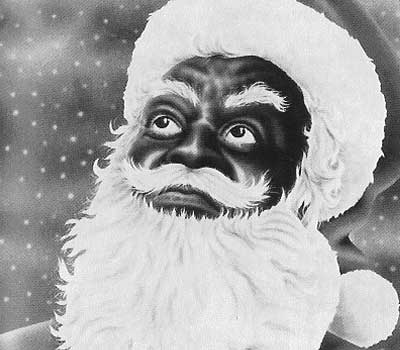
The 1960s and 1970s introduced popular images of black emancipation - 'black pride', 'black is beautiful', 'black power', 'black solidarity'. Derogatory images of black people were gradually pushed back and, along with a stronger presence of black people in media, more positive and 'normal' images appeared. Black people were no longer simply represented as servants, entertainers or sportsmen, but also as figures of beauty, elegance, soul and authority. This 1986 postcard attempts to break down stereotypes by going against the underlying cultural norms.
With this normalisation of images of African-Americans, however, came a split between 'good blacks' (middle class, mainstream, well-dressed) and 'bad blacks' (ghetto types). 'Good blacks' conform to mainstream standards in lifestyle whereas 'bad blacks' are associated with unemployment, drugs, crime and violence. 'Good blacks' parade in advertising and sitcoms, whereas 'bad blacks' populate the cop shows and rap videos, on the ragged margins of society, from the outside looking in. Thus being 'bad' has become a defiant counter-image for black youth.
'Good blacks' are cast as spokespeople for 'bad blacks', and the apparent success of the former defeats the claims to special treatment (positive or affirmative action) on the part of the latter. This is part of what has been termed 'the paradox of integration'.