William Hogarth
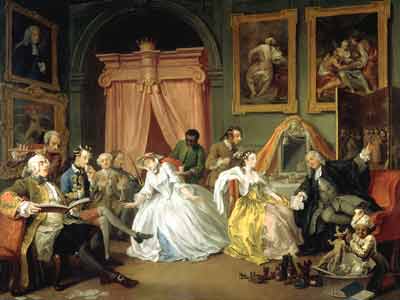
William Hogarth's 'Marriage á la Mode' series exposed the debauched lifestyles of the upper classes, their marital infidelities, sexual diseases, and artistic pretensions. Frame Four shows a group of aristocrats being entertained by an opera singer. The black man serving sugared chocolate is a symbol of the colonial wealth which finances the lavish expenditure of the aristocracy. High civilisation has its roots in inhumane economic exploitation.
The little black boy, kneeling beside a basket of artistic bric-a-brac and an auction catalogue, is a symbol of the connection between art and slavery. It is a symbol that had long-dwelt in Hogarth's mind. As far back as 1733, he had painted a study for 'The Rake's Progress' in which a black boy is placed in similar relation to art objects.
Hogarth, in juxtaposing black people and artistic bric-a-brac, was being faithful to fact, for in the 18th century many dealers in 'black Masters' (Hogarth's scornful term for grimy paintings all the more valued as 'Old Masters' because of the evidence of age) were also dealers in black slaves. In England, both 'commodities' were auctioned off in coffee houses. It is appropriate that, at the time, the term 'patron' still had the dual meaning of 'owner of slaves' and 'supporter of the arts'.
Leading connoisseurs and collectors of the age, like the duke of Chandos or the Beckford family, were heavily involved in the slave trade. In 1762, Allan Ramsay was to write that the revival of classical architecture and taste all over Europe was financed by colonial wealth.