Anon.
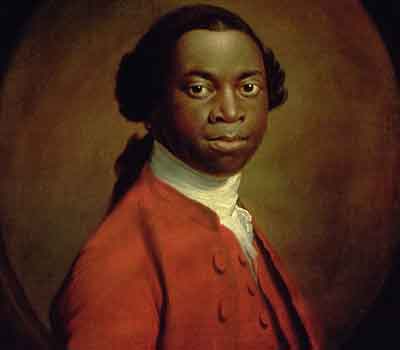
There are many doubts about the identity of the black man in this painting. Some have thought it to be a portrait of the 18th-century abolitionist Olaudah Equiano, while others argue that it could be Quobna Ottobah Cugoano. It was once attributed to Sir Joshua Reynolds, but Richard Cosway's biographer believes that Cosway did this painting - and Cugoano worked for Cosway.
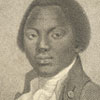 The engraving of Olaudah Equiano that appeared on the frontispiece of his book © There are similarities between the subject of this painting and Equiano. The subject is the very picture of an English gentleman. The forehead has been lit to suggest great intelligence, which would have gone counter to the prevailing racist notions in 18th-century British society that Africans were not as intelligent as Europeans.
In terms of his standing in Britain, Equiano was indeed a gentleman, assimilated into British society by his command of the English language, his friendships with the white elite and his marriage to a propertied white Englishwoman. His experience of different cultures, gained while travelling the world, had deepened his insights into human nature, and his intellect was reflected in the scholarly and literary qualities of his autobiography, published in 1789.
However, if one compares this portrait with the engraving of Equiano that appeared on the frontispiece of his autobiography, there can be little doubt that the man in the painting is not Equiano.