William Hogarth
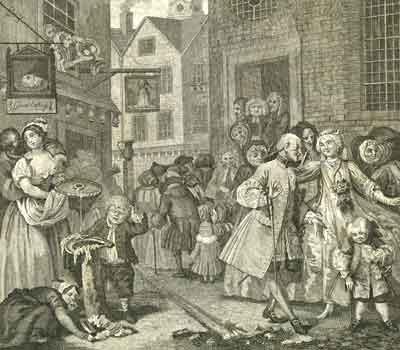
The prominence of the black man in William Hogarth's engraving indicates the high visibility of black people in 18th-century London and the degree to which they were integrated into 'low' society. So much so that in 1768, the magistrate Sir John Fielding complained that black slaves in Britain who ran away from their owners were difficult to recapture since they gained the sympathy and protection of London's 'mob'.
Hogarth's black man is very much part of the community of the poor whose lives revolve around food and sex. There is a quality of savagery, almost cannibalism, about them, conveyed in details like the sign boards. The first shows a headless maiden; the second, the severed head of John the Baptist served up on a platter above the inscription 'Good Eating' - itself flanked by two large teeth.
At the upstairs window of the tavern, male and female struggle over a piece of meat, the twin passions of hunger and of sex combined in their actions. The themes of food and sex are seen again in the spillage from the woman's plate as she is being fondled by the black man. He is a symbol of the 'savage' environment of the city, for 18th-century British writings frequently compared London to an African jungle - 'a land of barbarians, a colony of Hottentots.'