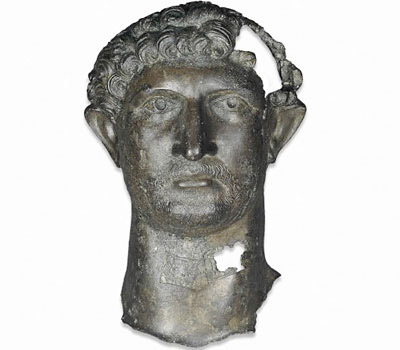
Hadrian
- Born 76 AD
- Reigned 117 - 138 AD
- Pivotal moment: Hadrian put an end to expansion and enclosed the empire within clearly marked frontiers.
Publius Aelius Hadrianus was related to the emperor Trajan on his father’s side, and was adopted by him. However, this was not announced until the day after Trajan’s death.
Though Hadrian had been groomed for succession - he was associated with Trajan in several campaigns and appointed to a succession of military and civil posts - his accession was not universally approved. Within a short time, four senators were executed - accused of plotting treason.
Trajan’s reign had been one of warfare and territorial expansion, when the empire reached its greatest extent. By contrast, Hadrian’s reign was one of peace and consolidation, except for a serious revolt in Judaea in 132 AD.
A cultured scholar, fond of all things Greek, Hadrian travelled all over the empire. He was attentive to the army and the provincials, and left behind him spectacular buildings such as the Pantheon in Rome and his villa at Tivoli. But his greatest legacy to the empire was his establishment of its frontiers, marking a halt to imperial expansion.
In Africa he built walls to control the transhumance routes, and in Germany he built a palisade with watch towers and small forts to delineate Roman-controlled territory. In Britain, he built the stone wall which bears his name, perhaps the most enduring of his frontier lines.
He was truly a pivotal emperor, in that he divided what was Roman from what was not. Apart from minor adjustments, no succeeding emperor reversed his policies.