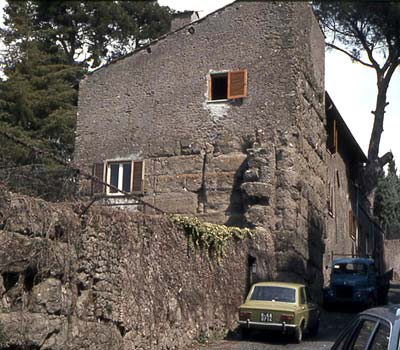
Tower of the legionary fortress at Albano
Reforms of Septimius Severus and Caracalla
The emperor Septimius Severus (ruled 193 - 211 AD) became emperor after victory in a civil war, and his reforms were principally designed to strengthen the ruling dynasty's position. He cashiered the old 'Italian' Praetorian Guard, replacing it with men recruited from the Danubian legions which first acclaimed him emperor. He further controlled the city of Rome by stationing a newly-raised legion nearby at Albano.
Severus personally led the armies of his defeated rivals against the empire's external enemies in Syria and Britain. As new provinces were established, so were new legions. Large provincial commands with three legions were divided so as to break up legionary concentrations. Military service was made more attractive by raised pay and an end to the ban on soldiers' marrying.
Severus' son and heir, Caracalla (ruled 198 - 217 AD), further raised pay and extended citizenship in 212 AD to all free (non-slave) members of the empire's population, thus making them eligible to pay certain citizen taxes, and thereby strengthening the army's financial base.