Priests
Priests
Religious activities of the Roman state religion were overseen and presided over by priests. They were drawn from members of the ruling class of Rome, and were organised in 'colleges' and sub-groups with particular functions.
For example, there were pontifices (pontiffs), augurs (associated with interpretation of auspices - signs given by the gods through the flight of birds, thunder, lightning, and other natural phenomena), haruspices (originally of Etruscan origin, consulted about prodigies), flamines or individual gods, and fetiales, associated with the declaration of war.
The chief priest was known as the pontifex maximus, a title that was subsequently used by Roman Catholic popes. In the Republican period of Roman history, the priests typically were also politicians, and religious rituals could be - and were - exploited for political advantage.
Religious revival was one of the most important policies pursued by Augustus, the first Roman emperor. In 12 BC he took the office of pontifex maximus for himself, and it remained a prerogative of the emperor, emphasising the link between politics and state religion, until Christianity became the official religion of the Roman empire.
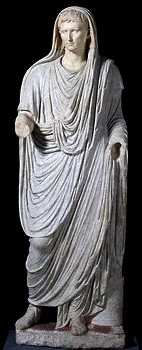
The image shown here is that of a statue from Rome, depicting Augustus - who is wearing the veil associated with Roman priests.