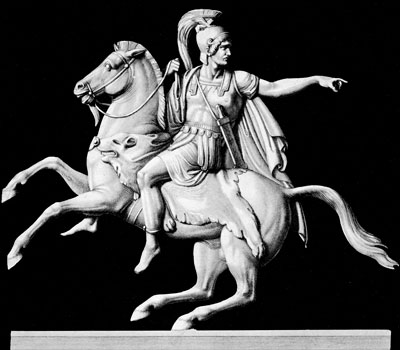
Hannibal, Carthaginian general and political leader
- Born 247 BC
- Died 182 BC
- Enemy of Rome: Carthaginian general famed for bringing his army, including elephants, over the Alps. Inflicted three huge defeats on Roman armies, including the largest ever at the battle of Cannae in 216 BC.
Born in 247 BC, Hannibal became commander of the Carthaginian forces in Spain, in succession to his father Hamilcar in 221 BC. At the time, Rome and Carthage were moving towards the outbreak of the second of the three so-called Punic wars (264-241 BC, 218-201 BC, and 149-146 BC) through which their conflict over the control of the western Mediterranean was eventually decided.
Hannibal took the war to Rome, and in May 218 BC conquered northern Spain before crossing the Alps in the autumn with 50,000 infantry, 9,000 cavalry and, famously, 37 elephants. In Italy he fought a protracted campaign, winning three huge victories over the Roman armies sent against him: at Trebbia in December 218 BC, Late Trasimene in 217 BC (where 15,000 Romans were killed and another 10,000 captured) and, greatest of all, at Cannae in 216 BC.
Here, Hannibal showed the mastery of the combined use of infantry and cavalry for which he was famous to surround and annihilate a huge Roman army. Of perhaps 70,000 Romans, only 14,500 survived to be taken prisoner at the end of the day. It is the greatest number of casualties suffered in a single battle by any western army before or since.
In the long run, he never received enough reinforcements to threaten Rome itself despite his army surviving in Italy for over a decade. Roman victories elsewhere meant that peace was eventually made on Roman terms in 201 BC. Hannibal then became involved - eventually unsuccessfully - in internal Carthaginian politics, and was driven into exile in 195 BC.
In 183 BC, he committed suicide by taking poison to prevent himself being handed over to the Romans.