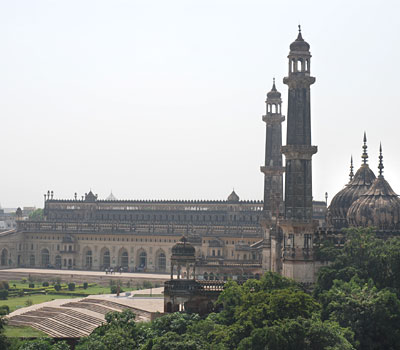
The Bara ('Big') Imambara
- Lucknow
- The Bara ('Big') Imambara, is one of the last great buildings constructed in the Mughal style and one of the most spectacular buildings in India.
- Lucknow was renowned for the high culture of the Awadhi court that had its capital there. Celebrated Urdu poets, qawwali singers and master chefs all thrived here until the British annexed the province in 1856. Many of the British Indian troops were high caste Hindus drawn from the province of Awadh, who played a large part in the revolt against the British in 1857.
In 1783, the Nawab of Lucknow, Asaf-ud-Daulah, started the building of an 'Imambara' (residence to an Imam) complex as a famine relief project. The Bara ('Big') Imambara, contains the tomb of its founder, Asaf-ud-Daulah. A feat of architectural engineering, the structure has no beams supporting the ceiling, and is famous for being one of the largest arched constructions in the world.
A Chhota ('Small') Imambara was also built some 50 years later by the Third Nawab of Awadh, Mohammed Ali Shah, also as an employment project during a time of famine.