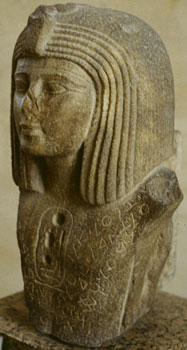
Bust of a statue of Osorkon I, found at Byblos, in Lebanon
- 22nd Dynasty
- Libyans had settled in Egypt from the 18th Dynasty onwards, and became well established in the north-west, with their own traditional leaders or chieftains. Some of these leaders married into Egyptian ruling families, and finally, around 975 BC, a member of one of these Libyo-Egyptian families became pharaoh.
Bearing such Libyan names as Shoshenq, Osorkon and Takelot, a series of these Libyo-Egyptian kings comprised the 22nd and 23rd dynasties. Initially, major efforts were made to restore Egypt's internal unity and international standing, and Shoshenq I undertook military campaigns into Palestine. Osorkon I, whose statue, shown above, can be seen in the Louvre Museum in Paris, was engaged in diplomatic efforts in the same area. However, internal conflicts developed once more, and by 840 BC the country was irrevocably split in two.