Egyptian world of the dead
For ancient Egyptians, it was of key importance that when someone died their physical body should continue to exist on earth, so they could progress properly through the afterlife. Consequently, providing proper eternal accommodation for their body after they had died was very important to them. The afterlife they wanted to attain was thought of as a bigger and better version of the earthly Egypt - and in it they were to live close to their family and friends.
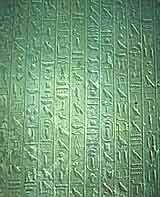 The Pyramid Texts © There was one exception to this rather homely vision of the next world. This was for the king, already a divine being on earth, who would complete his apotheosis on death. According to the earliest set of texts dealing with the next world, the Pyramid Texts, which were inscribed inside the royal tombs of 2500-2300 BC, the king would dwell with his fellow gods in the entourage of the sun-god, Re. He would spend eternity traversing the sky and underworld: one might be tempted to regard the fate of his subjects as more desirable.
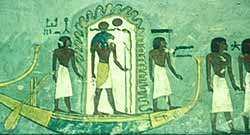 The sun god Re on his nocturnal journey, from the tomb of Ramesses I in the Valley of the Kings ©
The spiritual part of the dead person was believed to have a number of aspects, including the ba, the akh, the ka and the 'shadow'. Of these, the ba was depicted as a human-headed bird, in which form the spirit could travel around and beyond the tomb, able to sit before the grave, taking its repose in the 'cool sweet breeze'.
The concept of the akh was somewhat more esoteric, being the aspect of the dead in which he or she had ceased to be dead, having been transfigured into a living being: a light in contrast to the darkness of death, often associated with the stars.
The notion of the ka was even more complex, being an aspect of the person created at the same time as the body, and surviving as its companion. It was the part of the deceased that was the immediate recipient of offerings, but had other functions, some of which remain obscure. The deceased, in whatever ethereal form, however, required sustenance for eternity, and it was with this basic fact in mind that the Egyptians' tombs were built.