Buried clues
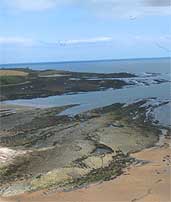
 Mesolithic footprints on the coast at Howick © The fact that we have found so little from Mesolithic times is what made the discovery that I heard about last year all the more remarkable. When amateur archaeologist John Davies spotted flint tools eroding out of the edge of a sandy cliff face near the village of Howick, in Northumberland, he reported his finds. When Newcastle University archaeologist Clive Waddington went to investigate, he realised that this wasn't just a scatter of flints on the surface, but the first indications of something deeply buried.
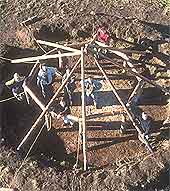
A small exploratory excavation showed that this was a Mesolithic house, dating back, on the basis of the flint tools found inside it, perhaps as much as 10,000 years. When I was told about it, this was what really intrigued me, as even at first sight, this was far more than the expected flimsy structure; it was both substantially built and very early in date. What could this, potentially the oldest house in Britain, tell us about life in the Mesolithic, and would it change some of our existing ideas?
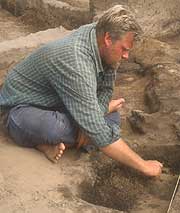
The excavation was far from easy. The sand was either baked rock hard, in which case all the vital colour differences that distinguished the individual layers simply disappeared, or it was wet - good for the colours but too soft to walk on. Boots were banned; it was either socks or bare feet. But somehow, over many weeks, the fragile structure of the house was teased out. It consisted of a shallow circular hollow, cut into the sand, a small segment of which had disappeared over the edge of the cliff.
Within this lay the structural evidence - a circle of substantial post holes, with charcoal stains in their bases, and a number of smaller stake holes, some angled in from outside the hollow. But what were even more remarkable were all the hearths that lay inside the house, shallow depressions filled with charcoal and burnt nutshells, flecked with fragments of bone, the evidence for 10,000-year-old meals.