| 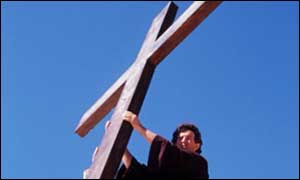 | | A man helping put up a cross |
| | Find out; why Easter is never on the same date - it's down to some church bureaucrats; why we give each other Easter eggs, and just how many we munch each year; also how a pagan goddess became the Easter bunny. |
| | | | WHERE DOES THE NAME COME FROM? | | | The early Christians took over a pagan festival in honour of the goddesses "Ostra", "Ostern" or "Eastre" where they celebrated the return of spring. Eastre became Easter. | | | WHY DOES THE DATE CHANGE EVERY YEAR? | | | Easter has always been a movable feast. Until A.D. 325 Easter was celebrated on Friday, Saturday or Sunday in March. The Emperor Constantine decided to try and fix a definitive date, but unfortunately left it in the hands of the bureaucrats, and the Council of Nicaea came up with a very complicated system. Their Easter Rule said that the festival should be celebrated on the first Sunday that occurs after the first full moon, on or after the vernal equinox. To make the date even harder to work out the ecclesiastical full moon often falls on a different day from the astronomical full moon. But Easter will always be between the dates of March 22 and April 25. | | | WHY DO WE GIVE EASTER EGGS? | | Eggs had a religious significance in many ancient civilisations; Egyptians buried eggs in their tombs as did the Greeks; A Roman proverb states, "All life comes from an egg". It’s probably no surprise that Christianity should also adopt the egg to symbolise the resurrection of Christ.
The first chocolate Easter egg appeared in this county in 1873. We eat a lot of Easter eggs in the UK - 80 million last year alone. Add to that almost 500 million cream eggs and you have a lot of calories.
The Chocolate Easter egg is a very British thing. In the USA they give Easter Bunnies and jellybeans. | | | WHERE DOES THE EASTER BUNNY COME FROM? | | | Blame that pagan festival again. The goddess, Eastre, was worshipped by the Anglo-Saxons through her earthly symbol, the hare. |
| | | |
|
|