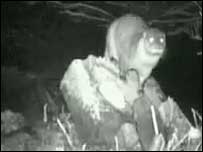
The night time activites of otters have been caught on film in Worcestershire, using special night vision cameras.
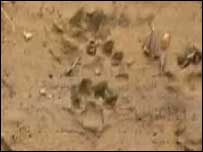
Otter footprints
The film was made after a local wildlife expert, Rosemary Winnall, spotted otter tracks near a stream.
Motion sensitive video cameras were put in place near where the tracks were found, and some remarkable footage was captured of these rare nocturnal creatures.
The location where the filming was done is being kept secret, to protect the otters.
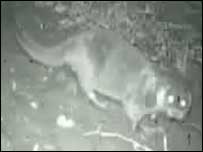
Glowing eyes
Otter facts
POPULATION
Recent surveys carried out by Worcestershire Wildlife Trust have shown that otters are now present on all of the county’s major rivers. The strongest populations seem to be on the River Teme and middle Severn, but they do also appear to be spreading up the River Avon. Young otters have also been found, indicating that breeding definitely occurs in Worcestershire.
Otters were once found throughout much of the UK, but they underwent a rapid decline in numbers from the 1950s to 1970s and were effectively lost from Midlands by the 1980s.
LIFE SPAN
Up to 10 years
DESCRIPTION
Head and body length: 55-110cm, Weight: 5-12kg. They have a long, slim body and a skull with powerful jaws, and have numerous adaptations to aquatic life. These include webbed toes and a powerful rudder-like tail, used for propulsion under water. Otters are capable of closing their ears and nostrils while underwater. They have two types of fur; stout waterproof guard hairs and a dense, fine underfur which provides insulation. Their fur is chestnut brown and is slightly lighter on the belly.

Getting friendly with the camera
DIET
Apart from fish, otters also feed on crustaceans, water birds, frogs and voles. They can use their whiskers as sensing organs underwater, to monitor the movements of prey.
REPRODUCTION
Otters breed all year round, with a gestation period of about 63 days, after which two or three cubs are born. These are blind at birth and are covered in a dark or grey downy fur, finally opening their eyes after 35 days.
The cubs will remain inside the holt, in a nest of straw or weeds for a further couple of weeks, before venturing out into the open with their mother. The cubs are weaned after three to four months and reach sexual maturity after two to three years.