| 13 November 2014 |

| |
| BBC Homepage | | |
| |||
| Contact Us | | |
Places StoriesYou are in: Hereford and Worcester > Places > Places Stories > The two sides – the Houses of Lancaster and York 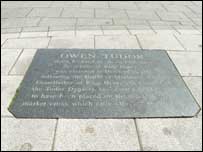 Memorial to Owen Tudor The two sides – the Houses of Lancaster and Yorkby Nicola Goodwin The two sides in the Battle of Mortimer's Cross, the Houses of Lancaster and York, were closely linked and related in many different ways. The House of LancasterHenry VI had become King on 31 August 1422 following the death of his father Henry V. Henry VI was only 8 months old when he took the crown and although he impressed everybody with his intelligence as a child, it’s said that he became a weak and obstinate man who was easily led. He liked to spend money and by the time of the Wars of the Roses, he had almost bankrupted the crown. 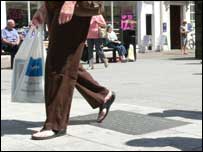 Memorial in High Town Although he regained power on October 30th 1470, he lost it again on April 11th 1471 and he was murdered at the Tower of London aged 49. His side at Mortimer’s Cross were led by Owen and Jasper Tudor, Henry’s stepfather and half brother. Owen Tudor had married Henry V’s widow Katherine de Valois. Jasper is described in history as brave, tenacious and resourceful but it’s also documented that he lost his nerve at the Battle of Mortimer’s Cross. He’s believed to have fled before the battle started, maybe realising that they stood little chance of victory. The Tudors were joined by men from across Wales and the southern counties including the Scudamores from Kentchurch Court and the Hereford lawyer Thomas Fitzharry. The House of YorkEdward, Earl of March, is described as good looking, tall, strong and athletic. He was only 18 when he fought at the Battle of Mortimer’s Cross but he’s said to have been a good leader who inspired the men around him. He was open, charming, friendly and generous in his youth and he knew the area very well and would have hunted in the woods at Aymestry, Shobdon, Lingen and Wigmore. His estate included Wigmore Castle which was managed for him by Sir Walter Devereux of Weobley. Devereux fought in the battle as did most of Herefordshire’s noblemen including William and Richard Herbert, Lord Grey of Wilton near Ross, John Lingen (who is buried in Aymestry Church), Richard Croft of Croft Castle (who is buried in Croft Church) and Roger Vaughan of Hergest Court near Kington (who is buried in Kington Church). The Herberts and the Vaughans were half brothers and there’s no doubt that Edward’s popularity locally would have gained him an army of local men who knew the area extremely well. The victorious and the executedTotally different fates awaited the key men following the House of York’s victory at the Battle of Mortimer’s Cross. Edward, Earl of March, went on to become Edward IV and was crowned on March 4th 1461. He stayed in power until October 3rd 1470 when he was exiled but he then regained power on April 11th 1471 and enjoyed an unchallenged second reign as King until he died suddenly aged 40 in April 1483. Edward knighted most of Herefordshire’s noblemen and lords who fought for him at Mortimer’s Cross including Richard Herbert, Roger Vaughan and the Lords of Baskerville, Croft, Lingen and Knill. Thomas Vaughan was given a royal stewardship and Richard Croft was given the manors of Leintwardine and Burford to add to his Croft Castle estate. Dozens of Lancastrians were captured, taken to Hereford and held there for up to three weeks before they were beheaded. The most well known of those executed was Owen Tudor who was kept prisoner in the Green Dragon Hotel the night before his death. 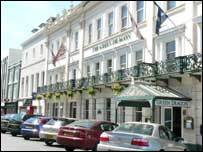 Green Dragon Hotel Hereford The Green Dragon is still operating as a hotel and is one of the city's oldest buildings. He was led to the block in High Town by Roger Vaughan and, according to Professor R A Griffiths and Roger Thomas in The Making of the Tudor Dynasty, he didn’t realise that he was about to meet his death until he saw the axe and block and the crowd gathered around. His red collar was torn off and he’s said to have smiled at the irony of ‘the head that was won’t to lie on Queen Katherine’s lap’ being cut off on a rough block. After his execution his head was washed and his hair and beard combed and placed on the top step of the market cross in Hereford surrounded by a hundred candles. A plaque in Hereford’s High Town marks the spot where the executions took place. I wonder how many people today look down at the spot as they walk across High Town? Other Lancastrians faired better. Jasper Tudor caught Roger Vaughan in 1471 and took his vengeance on the man who had led his father to his death. Thomas Fitzharry, a Welsh lord, and many of the Scudamores managed to escape and live long lives. Despite the many years of fighting, the houses of Lancaster and York were united when Edward IV’s oldest daughter Elizabeth married Henry Tudor. All the kings and queens of England since have been descended from them. last updated: 03/09/2008 at 11:32 SEE ALSOYou are in: Hereford and Worcester > Places > Places Stories > The two sides – the Houses of Lancaster and York [an error occurred while processing this directive] |
| | About the BBC | Help | Terms of Use | Privacy & Cookies Policy |