 | 13 November 2014 |

| |
| BBC Homepage | | |
| |||
| Contact Us | | |
AstronomyYou are in: Hereford and Worcester > Nature > Astronomy > The skies in December 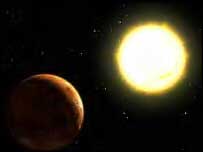 55 Cancri The skies in Decemberby Martin Humphries The most spectacular meteor shower of the year takes place this month. Well, I've been going on about it for the entire year, and now we're almost there! The planet Mars, which was a pretty miserable sight twelve months ago, has gradually increased in brightness throughout the year, and will finally reach "opposition" at 19:40 UT (Universal Time - same as GMT) on Christmas Eve.  Mars seen through a telescope This means that Mars is in the opposite part of the sky from the Sun, and the planet will be at its closest to the Earth, and will therefore appear at its largest, and we shall also see it "face-on". Both these factors contribute to Mars appearing just about as bright as it can ever get. In fact, it will be about 16-times as bright on Christmas Eve than it was 12 months ago! You can see it about 35° above the E horizon in the early evening and about 65° high in the S at midnight. By chance, Mars - which is still exhibiting its retrograde motion (see the November 2007 Newsletter for more information) - will also have an apparent "close encounter" (or, in astronomy-speak, "be in conjunction") with the Moon at 03:42 UT in the early hours on the same day, when the two bodies will appear only 0.3° apart. The Moon will be full, so its brightness is bound to have some effect on this spectacular event, but do have a look if you are up and about at that time, and I think you'll find that Mars really is the Christmas "star" of 2007. Shooting starsThe second great spectacle of the December skies is the Geminids meteor ("shooting stars") shower, the most prolific one of the entire year, and which peaks on 14 December. Look out any evening between 7 and 16 December, and you should see some Geminids, but look out particularly on the evenings of 13 and 14 of the month, and you could see up to 100 meteors per hour. The radiant (the area of the sky from which the meteors appear to originate) is near to the bright star Castor, in the constellation of Gemini, which is about 40° high at 21:00 in the E on 13 and 14. 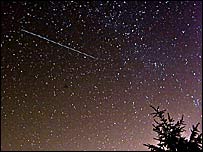 Look for the Quadrantid Meteor shower The Moon is only about 5 days old so the viewing conditions are very favourable, and a rich display of slow meteors, with a good proportion of them quite bright, can be expected. There is a second, but minor, meteor shower in December, the Ursids, but its maximum, also on Christmas Eve, will mainly be "washed out" by the bright full Moon. However, if you do look out for Mars on the evening of 24 December, spend a few minutes looking for this shower, as it occasionally (last time about 20 years ago) puts on a pretty spectacular display. Winter solsticeThe Winter solstice will occur at 06:07 UT on 21st of the month - this is the moment when the Sun changes its apparent movement against the background stars from southerly to northerly, meaning that, for those of us living in the northern hemisphere, the hours of daylight will gradually increase and we shall start moving towards spring. There's still most of winter left to get through first though! Although 21st of the month is the shortest day of the year, in reality it's only a few seconds shorter than the days either side of it. Venus rises about 04:00 UT, some four hours ahead of the Sun, in the SE at the beginning of the month, and at about 05:00 at the end, although then it will be less that 20° high in the sky at Sunrise. The planet will still be spectacularly bright though, and if it weren't for Mars' opposition on Christmas Eve this year, would have had to be a contender for the 2007 Christmas "star". And no, there is no real evidence that Venus was the Star of Bethlehem, even if, indeed, that Star really existed at all. The BBC is not responsible for the content of external websites Jupiter is in conjunction (i.e., positioned on the other side of the Sun from Earth) at 05:53 UT on the 23 December, so is not visible at all this month. Saturn rises well before midnight in the E at the start of the month, and can be seen close to the half-moon before Sunrise on 1st. It rises at about 21:00 at the end of the month, and once risen, remains visible through the night for the entire month. New planetDid you see that a new planet has been discovered circling the star 55 Cancri? It's been reported that NASA claims that the planet is "easily visible" through binoculars, so if you want a real Christmas challenge, here's how to find it. The constellation Cancer, the Crab, is quite dim and not easy to spot, so begin by finding the beautiful Beehive Cluster, which is right in the centre of Cancer, at about 22° high in the E at 22:00 in the middle of the month. Then look about 5° up and to the left to the dim star iota-Cancri. Although it's dim, iota-Cancri is the brightest object in that part of the sky and is visible to most people with the naked eye. 55 Cancri is about 1° below iota-Cancri, and just about on the limits of naked-eye visibility under ideal conditions, so you'll need at least binoculars to find it. Once 55 Cancri is found, the planet is "easily visible" - or so they say! Well, that's it for 2007. In the January Newsletter, we'll have a look at what 2008 has to offer, but in the meantime, have a Merry Christmas, and don't forget to Watch the Skies! Martin Humphries. last updated: 26/09/2008 at 12:00 You are in: Hereford and Worcester > Nature > Astronomy > The skies in December   
| ||||||||||||||||||||
| | About the BBC | Help | Terms of Use | Privacy & Cookies Policy |

