 | 24 September 2014 |

| |
| BBC Homepage | | |
| |||
| Contact Us | | |
nature starsYou are in: Hereford and Worcester > nature > nature stars > The skies in November 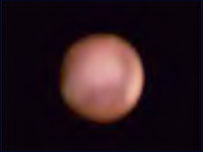 Mars (photo:Tony Hatwood) The skies in NovemberBy Martin Humphries Now could be the time to see a new comet with the naked-eye... New cometI'm wary of mentioning a new or relatively unknown comet since Comet McNaught, earlier this year, delivered the goods in Australia but failed to deliver here, leaving me with a fair amount of egg on my face! But let's live dangerously again: there is a bright naked-eye comet - Comet Holmes - in the sky (at the time if writing!) Find the bright star Mirfak in the constellation Perseus about 65° high in the ENE at 22:00 UT. Then find the brighter star Capella in the constellation Auriga about 45° high, also in the ENE. "Draw" an imaginary straight line between them, and the comet as about a quarter of the "line" away from Mirfak, and currently the third brightest object in Perseus. It only looks like a fuzzy star with the naked eye at the moment (it's better through binoculars), but is still brightening and is certainly appearing larger by the day, so over the next week or so, who knows? MarsThe planet Mars makes the most (reliable!) interesting sight in the skies this month, and I'll explain why shortly. But first, you can find it about 15° above the E horizon at 22:00 UT in the constellation Gemini. It's the brightest object in that part of the sky and a distinctive red colour. Don't confuse it with Betelgeuse, in Orion, also red but lower in the sky and about 20° further S. By the end of the month at the same time, Mars will be about 35° high in the E at that time. As we know, Mars doesn't stay in a fixed position against the background stars, but moves over time, normally from E to W relative to the background. Occasionally though it appears to move from W to E against the stars, and this will start to happen in the middle of the month, which is why Mars is so interesting at the moment. This phenomenon, known as "retrograde motion", is a line of sight effect, and of course Mars will actually continue to travel in its orbit in the same direction as ever. From one night to the next, Mars' movement against the background stars is almost imperceptible, but if you plot its relative position on a star chart every three or four nights, its movement usually becomes obvious. For example, Mars appears very close to the star Mebsuta in Gemini throughout the month. It's about 1.5° lower in the sky than the star on the 1st of the month. On the 8th Mars it's about 2° lower than the star, so is clearly moving away from it, and about the same on the 15th. On 22nd, it's about 1.5° lower again; i.e., it's changed direction. And at the end of the month it's only 0.5° lower than the star. In December Mars will move past Mebsuta, and this retrograde motion will continue until about the middle of February next year. MercuryMercury is currently a morning object and will rise about 1½ hours before the Sun at the beginning of the month. It will reach its greatest Western elongation (i.e., its greatest angular distance to the right of the Sun) on 8th of the month. Mercury is always a difficult object to spot, but on this occasion will be quite bright and the easiest to see as it ever is. Look out for it low in the E between (if you are up early enough!) 05:20 and sunrise. After this date, Mercury appears to move back ever closer to the Sun again until it's washed out in the dawn glare. And that's the last we shall see of Mercury until the New Year. Other planetsVenus is still a brilliantly bright morning object, rising in the E about 3½ hours before the Sun. Jupiter, also bright, but not as bright as Venus, can be seen very low in the SW at sunset at the beginning of the month, but appears closer and closer to the Sun as the month progresses until, like Mercury, it gets lost in the Sun's glare and won't bee seen again until 2008. Saturn rises in the E at about 01:00 UT at the beginning of the month and about 23:00 at the end, and remains in the sky until daybreak. Its famous rings are still visible using a small telescope. Shooting starsThere are a couple of meteor ("shooting star") showers during November. The Taurids' maximum occurs early in the month, so look out about the 3rd/4th, and although rates per hour are pretty poor, these slow meteors often contain a high percentage of fireballs - this was certainly the case in 2005. The radiant (the area of sky from which the meteors appear to originate) is high in the SE at around midnight. The second shower this month, the Leonids, are rather more prolific. If you look out in the early hours of the morning of 17th/18th November, the radiant will be, as the shower's name suggests, in the constellation Leo, in the E. The Leonid meteors tend to be very fast, but, like the Taurids, also produce a high proportion of bright meteors, leaving persistent "trains". Watch the skies! Martin Humphries. last updated: 19/03/2008 at 10:31 SEE ALSOYou are in: Hereford and Worcester > nature > nature stars > The skies in November
|
| | About the BBC | Help | Terms of Use | Privacy & Cookies Policy |



 Watch the