 | 7 November 2014 |

| |
| BBC Homepage | | |
| |||
| Contact Us | | |
nature starsYou are in: Hereford and Worcester > nature > nature stars > The skies in October 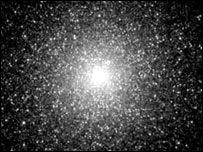 M15 globular cluster The skies in OctoberBy Martin Humphries World's first satellite anniversary, spectacular shooting stars, and a "must see" sight on the 7th... SputnikI want to start this month's newsletter commemorating the 50th anniversary of one of the most far-reaching man-made astronomical events in history - the launch of Sputnik I, the world's first artificial satellite, at 19:12 UT (Universal Time - same as GMT) on 4 October 1957 by the then USSR. Shocking political news for the West - here was proof that Russian technology was far ahead of Western, and particularly American, technology! But there was more to it than just being first. The Americans had also planned to launch their own earth Satellite, Vanguard, in 1957, but this weighed just over 3 lbs compared with Sputnik 1, which weighed over 180 lbs! America's humiliation was compounded by a series of failed Vanguard launch attempts following Sputnik I, and the events of this whole unhappy time for America prompted their government to set up the National Aeronautics and Space Administration (NASA) in October 1958, "… to provide for research into the problems of flight within and outside the Earth's atmosphere, and for other purposes …". I firmly believe that if an American satellite had been first in orbit instead of Sputnik I, there would have been no "space race", no NASA, and possibly, even yet, no man on the Moon! BST endsNow for a bit of "housekeeping" before we move on. British Summer Time (BST) ends in the early hours of the 28th - we "put the clocks back", so the last few days of the month are in Greenwich Mean Time (GMT). But in this Newsletter we shall, as usual, quote times in Universal Time (UT) throughout, which, conveniently during the winter months, is the same as GMT. Mercury and VenusThe planet Mercury is in the sky in the daylight hours this month so is never visible, but Venus is now a spectacular morning object, rising at 02:17 U.T. in the E at the beginning of the month and 02:35 at the end. It sets during the mid-afternoon throughout the month, long before Sunset. It starts the month as bright as it ever gets, and although it becomes marginally less bright as the month progresses, it will still be a magnificent sight. It reaches its greatest Western elongation on the 28th, when it is at its greatest angular distance from the Sun, some 36° high in the sky at Sunrise. MarsThe red planet Mars rises in the NE at about 21:00 at the beginning of the month and 22:00 at the end, and is visible throughout the night. It's going to be bright, with its red colour making it unmistakable. The planet's at its highest in the sky, at 60° above the S horizon, just before Sunrise. Jupiter and SaturnJupiter sets in the early evening, and is low in the SW sky for only a couple of hours after sunset. Saturn rises in the early hours and remains visible throughout the rest of the night. It too is at its best just before sunrise as it is then at its highest in the sky, in the ESE. It's also in the same part of the sky as Venus, and at the beginning of the month these two planets form a spectacular triangle of objects with the bright star Regulus in the constellation Leo. On the 7th, they are joined by the 4-day-old Moon, which almost occults (i.e., covers up) Regulus - a "must-see" sight! The moonAt about 22:30 on 27th the Moon will have an even closer encounter with the star cluster the Pliades, and over the next couple of hours it will gradually cover then again uncover several of its stars. The Moon will be nearly full, so unlike the near-occultation of Regulus, its bright light will "wash out" all but the brightest of the stars. Shooting starsThe Orionids meteor ("shooting stars") shower is at its peak in the early hours of 20th October. If you look out at 23:00 UT of the 19th, you will see that Orion is very low in the E; the "radiant" (the point in the sky from which the meteors appear to originate) is only about 10° above the horizon, so you really should, if you can, wait an hour or two to see the meteors at their best. The shower produces up to 25 fast meteors per hour, many of which have persistent "trains" (trails of faintly glowing, ionized gas) which can still be seen after the meteor itself has burnt out). "A"-listFinally, we seem to have got out of the habit of looking at one of the Jodrell Bank's "A"-List of the 50 best astronomical items for relatively inexperienced amateurs to see, so let's get it going again. This month, try to find the globular star-cluster M15. You'll need a pair of binoculars as it's not bright enough for naked-eye observation, but you can find it 50° high, due S, at 21:00 on first of the month. It's also about 5° to the right of, and a little higher than Enib, the brightest star in that part of the sky, so it's fairly easy to find. M15 is one of only 150 known globular clusters, all of which date back to the early days of the universe. It contains over 100,000 stars, and its centre has the densest concentration of stars known. Sadly, binoculars won't show it in all its glory, but do try to see it all the same. Watch the skies! Martin Humphries. last updated: 19/03/2008 at 10:29 SEE ALSOYou are in: Hereford and Worcester > nature > nature stars > The skies in October
|
| | About the BBC | Help | Terms of Use | Privacy & Cookies Policy |



 Watch the