 | 7 November 2014 |

| |
| BBC Homepage | | |
| |||
| Contact Us | | |
nature starsYou are in: Hereford and Worcester > nature > nature stars > The skies in September 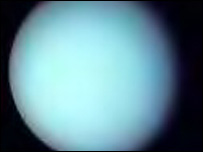 Uranus The skies in SeptemberBy Martin Humphries September offers a rare chance of seeing Uranus, but you'll need binoculars or a telescope... September already - where did the Summer go? The days will shorten noticeably and the night skies will get darker, so it's not all bad news for astronomers! The equinox will occur at 09:51 UT (Universal Time - same as GMT - add one hour for BST) on Sunday 23 September when the Sun will cross the celestial equator in a southerly direction. In fact, the days are shortening at their fastest rate for the entire year then - the day after the equinox is some eight minutes shorter than the day before, and the last day of the month is nearly two hours shorter than the first day! EclipseStill thinking about the Sun, there's an eclipse on Tuesday 11 September, but it's only a partial one and none of it can be seen from here anyway. And it's also interesting to note that the next sunspot cycle, which should be well underway by now, wasn't showing any great signs of activity at the time of writing - but once it does start it's expected to be a particularly active one. And don't forget - never look at the Sun with binoculars, telescope etc., in fact no optical instrument of any sort, as this is almost certain to cause severe and permanent eye-damage. PlanetsOn to safer things to look at - the planets. Mercury will not be favourably placed at all for local observation this month, and Venus is now well and truly a morning object. It rises about an hour and a half before the Sun at the beginning of the month and nearly four hours earlier at the end. The planet will exhibit a crescent shape through binoculars, and the proportion of the planet's surface in sunlight as seen from Earth will noticeably increase as the month progresses. However, as Venus was in superior conjunction (placed between the Earth and the Sun) on Wednesday 15 August, it will move further away from the Earth during September, and its angular diameter will decrease accordingly. However, the broadening crescent shape will compensate for that, and the planet will remain very bright throughout. Mars will rise at 22:13 UT at the beginning of the month and about an hour earlier by the end, and its brightness will increase over that period. It is in the constellation Taurus at the moment and soon after rising can be found in the E, about 15° left of the red star Aldebaran, the "eye" of the Bull. There's not much chance in getting the two confused though, as Mars is noticeably the brighter of the two. Mars itself will continue to increase in brightness now, right up to the end of the year when it will be a very spectacular object indeed. Jupiter is still not well placed, and will set at about 22:00 UT at the beginning of the month and 20:00 UT at the end, although it too will remain very bright throughout the month. Saturn, which reached inferior conjunction (placed the other side of the Sun from the Earth) on Tuesday 21 August so was lost in the Sun's glare, will rise about an hour before Sunrise by the end of September, but despite being reasonably bright, may only just about be visible in the dawn sky. Rare Uranus viewingAn uncommon opportunity to find and see the planet Uranus will occur around Sunday 9 September, when it will reach opposition (i.e. will be pretty well exactly opposite the Sun in the sky), so it will be at its nearest to the Earth and at its brightest for the next year or so. However, its brightness (or should it be dimness?) is close to the limits of naked-eye visibility under ideal viewing conditions, so there's little chance seeing it with the naked eye under the light-polluted skies that blight most towns and cities. However, it should be visible using a modest pair of binoculars, providing you can actually find it! Fortunately, an imaginary line drawn through the two most westerly stars of the very prominent "Square of Pegasus" points more or less directly at it at 10 minutes past midnight UT on 8th/9th of the month, when Uranus will be just over 30° high, due South. If you do manage to spot it, you might just about be able to detect its pale greenish colour. Minor meteor showersAfter August's magnificent Perseid meteor ("shooting star") display - particularly on the night of 12th/13th of the month - September has a couple of minor showers, both designated as Piscids. The first shower peaks on Saturday 8 September, when you might see about 10 per hour, and the second shower peaks on Friday 21 when you might see about five per hour. However, there are always a small number of meteors visible that are not associated with any recognised shower, and these are referred to as "sporadic". Their numbers are not evenly distributed throughout the year though, and more are visible (10 or 12 per hour) during August and September than at other times. They can appear in any part of the sky and can be seen travelling in any direction, and they do add significantly to the spectacle. Watch the skies! Martin Humphries. last updated: 19/03/2008 at 10:28 SEE ALSOYou are in: Hereford and Worcester > nature > nature stars > The skies in September
|
| | About the BBC | Help | Terms of Use | Privacy & Cookies Policy |



 Watch the