Cut back early flowering perennials Some early flowering herbaceous perennials are best cut back as soon as they finish flowering, as this will prevent them from setting seed which could weaken the plant and so reduce its life expectancy. A prime example here are Lupins, plants which have only a relatively short life in any case, and this period can be foreshortened by allowing the flowering spikes to mature into columns of seed pods. Rapid removal of faded flower spikes, not only prevents this energy sapping process but also helps to encourage the production of another flush of blooms. 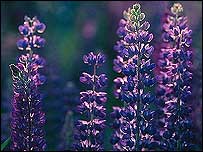 | | Lupins |
I seem to be getting asked a lot lately about young Lupin plants, bought from nurseries and garden centres, flowering well in the first year and then not sprouting up again the following Spring. This I feel sure is due to the young plants exhausting themselves producing flowers and masses of pods full of seeds, before the roots become properly established in the soil. So the dead-heading of young plants is particularly important, as is the control of the Lupin aphid. These are large aphids that have moved over here from America, often lurking unnoticed on the base of the stems, sucking away at the sap and thus weakening your plant. Using one of the organic pest control sprays containing rape seed oil usually sorts them out. Early flowering hardy geraniums, or crane’s-bills, can also be cut back quite hard now, just remove the older foliage and stems that are falling forward in order to allow the new leaves to sprout up in their place. Although the plants can look rather bald for a while the next lot of leaves, usually accompanied by a bright flush of blooms will soon appear to fill the gap. As ever an application of high potash fertiliser will help the re-juvination process along nicely. 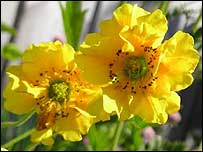 | | Yellow Geums |
Geums and Delphiniums are other examples of herbaceous perennials, which can be cut back almost to ground level. The only disadvantage is that this can, initially, leave quite large gaps in your borders until the plants have time to re-generate. Sometimes you can alleviate this problem by temporarily moving a specimen plant in a tub to fill the opened up area while the pruned plants recover. Potato blight Over the last couple of years we have experienced ideal conditions for the spread of this difficult to control fungal disease, which devastates potato and tomato crops. The warm, moist conditions are just what the disease revels in and this is the time to look out for attacks and take some action to prevent its spread. So what should we be looking for? The main symptoms appear on the foliage of your crop. The leaves show dark brown / black blotches, sometimes with paler margins, these being often concentrated at the leaf tips or edges, while in damp conditions a white mould grows on the undersides of the blotches. 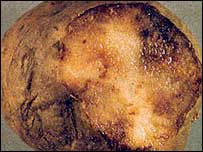 | | Potato blight |
Once it starts the problem usually spreads very rapidly often reducing the foliage to a brown rotting mass, and if left long enough the spores then begin to attack the potato tubers. In the case of tomatoes, the foliage symptoms are similar but often less severe, but dark streaks and spots begin to appear on the stems and green fruits, while the more mature fruits decay rapidly. If you have experienced attacks of potato blight in previous seasons it is definitely worth giving your plants a preventative spray with either Bio Dithane 945, Bordeaux Mixture, or Traditional Copper Fungicide straightaway and repeat the dose about 14 days later. As ever it is always worth removing the infected foliage and disposing of it in the dustbin, as this can help to limit the spread of the disease. Where your potatoes seem to be attacked regularly, try growing a variety that is blight resistant. Among the best at the moment are Sante, Remarka, Valor and Robinta. | 








 Watch the