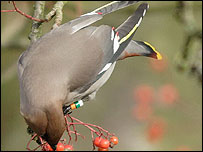
| Waxwing facts | - Waxwings get their name from the waxy-red tips to some wing feathers
- They breed throughout the wooded areas of Scandinavia, Siberia and North America
- Waxwings winter south of their breeding range, wherever there is a good crop of berries
- The largest flocks so far this year have been in Scotland, but flocks of up to 50 waxwings have been seen at many locations throughout eastern England, and more are expected as the Scottish birds filter south
- Influxes of waxwings are often associated with severe weather, though availability of food is a more likely factor
|
This is a most exciting winter for bird watchers – we have seen the biggest winter eruption of Waxwings in living memory, and possibly the biggest for hundreds of years. Waxwings nest in northern Scandinavia, Finland and Russia at the northern edge of the tree line. Every-so-often there is a very productive breeding season followed by a poor supply of berries – the food which normally sustains waxwings through the winter and when this happens the birds move SW, away from the arctic winter. Eruptive movements to Britain have been recorded since 1686! In more recent times the biggest influxes were in the 1950s and particularly in the winter of 1965-66, but these were small compared with the present winter. This winter thousands of birds arrived in NE Scotland in September and October. Many were caught by licensed bird ringers and some were given a set of colour leg rings to identify each individual. The results from ringing and simple observations of flocks have been fascinating. One ringed bird from Scotland turned up a few days later in Holland, although many have stayed put in Scotland, whilst others have swept south through England and Wales in a great wave, and flocks of 600 have been seen! It is very easy to watch Waxwings because when they gorge on ornamental rowan berries on trees that are often in towns, villages and gardens, and the birds usually ignore people. Instead of flying off they sit and eat and this is a good time for people to watch and look for colour rings. Modern digital cameras coupled with telescopes have produced some beautiful and informative pictures of birds bearing colour rings. Two such birds have been recorded in Worcestershire – in Pershore and Droitwich. 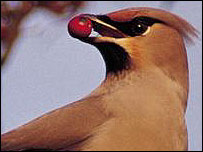 | | A Waxwing |
Apart from this, watchers have been amazed to see rowan trees dripping with waxwings! Dense flocks of hundreds were seen in Worcester, Droitwich, Kidderminster, and various places in the West Midland conurbation. Smaller flocks were seen in many places, including Evesham, Pershore, Defford, Little Comberton, Broadway, Leominster, Hereford, Malvern, Upper Sapey, Tenbury Wells, Ludlow and many others. One colleague was astonished to look up from exercising in the gym in Davis Road, Evesham, to see waxwings feeding on a tree outside the window! Waxwings are handsome They are about starling size, warm reddish brown, with striking yellow marks on the tip of the tail and in the wing. A prominent crest stands up from the top of the head and the inner wing feathers have bright red waxy tips. It’s now February and Waxwings will still be around until May (Spring is late on the arctic fringes) so please keep a lookout for the birds and especially please look for colour rings and send me your records. Accuracy is important  | | Look out for colour rings on Waxwing leg |
It is very important to note the exact sequence of rings on the bird’s leg starting from the top so you record something like red over blue over white. Also note which leg the rings are on (there will be small numbered metal ring on the other leg), and the date and place. I will of course let observers have information about the bird obtained from your observations. It will be interesting to see what happens when the rowan berry crop is eaten. Will the birds turn to rose hips (they often do) or cotoneaster and other garden berries, or will they move on to France? Your observations of flocks or colour rings will be very helpful in piecing together the details of this amazing waxwing movement – please send me your records! Harry Green Harry is a regular contributor on BBC Hereford and Worcester, and he can be contacted by e-mailing Presenter katie.johnson@bbc.co.uk |