Wealth of wet habitats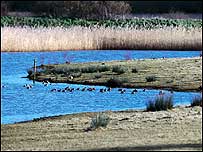 | The Exe Estuary is one of England's smaller estuaries, but it supports a wealth of habitats.
This is a traditional stopping point for migratory birds, including Avocets, Curlews, Lapwings, and Brent Geese. | | Bowling Green Marsh. |
The Exe Estuary's mud is rich in bird food such as Lugworms, which the waders dig down deep to find.
In winter, during floods and at high tide, bird watchers can see thousands of ducks, geese and wading birds roosting and feeding.
Hundreds of Avocets can also be seen on the estuary in winter. These once rare birds are now increasing in numbers. This distinctive bird is characterised by long, spindly legs and its upwardly curved, black beak.
The Curlew is another distinctive visitor, distinguished by its downturned beak which it uses to probe deep into the mud for food.  Bird paradise Bird paradise
In the mid winter there's 25,000 birds in the Exe estuary. Thousands come down from northern Europe to join resident species and feed on the rich marine life. Brent Geese winter here after flying all the way from Siberia to feed on the grassy fields alongside the estuary. After they've fed on a specific patch of grass, they return exactly four days later to the same spot, allowing the grass to regenerate and produce the nutrients that the birds need.
Although the great expanse of mud in the estuary looks bleak, it's a birds' paradise, full of cockles, lugworms and other food. Bowling Green Marsh One of the best places to watch the birds is at Bowling Green Marsh outside Topsham, five miles from Exeter. One of the best places to watch the birds is at Bowling Green Marsh outside Topsham, five miles from Exeter.
The marsh is located in a narrow part of the estuary further upstream. Bowling Green Marsh boats a great selection of birds including Waders, Wigeon, Shovelers, Pintails, and Teal. Lapwings are easily spotted by their black and white colouring, distinctive headcrest, and twitching leg designed to disturb invertebrates in the soil. Environmental pressures Sadly, man's influence on the environment has put some of these breeding grounds under threat. Sadly, man's influence on the environment has put some of these breeding grounds under threat.
Now the Royal Society for the Protection of Birds (RSPB) is sculpting the landscape in a different way, in an attempt to preserve the fragile ecosystem.
The RSPB is aiming to return Goosemoor, six hectares of pasture land at the head of the Exe Estuary, to its original state as an intertidal habitat.
The site is right next door to the existing wildlife reserve at Bowling Green Marsh.
One of the birds the RSPB is hoping will make a home there is the Avocet.
They already spend the winter on the Exe, but the RSPB wants them to stay and breed along with other waders like Redshank.
If they do get the Avocets to move in, the estuary would become the most westerly habitat in the UK that the birds visit.
Photographs courtesy of RSPB. | 






