Royal park in the city's heartland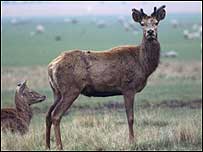 | One of London's four Royal parks, Richmond Park is the largest open space in the capital city, covering almost 1,000 hectares of natural habitats.
It is home to a huge variety of wildlife and nature activities including deer watching. | | Haven in the heart of the capital |
Although all 13 miles of the perimeter of Richmond Park are surrounded by human habitation, the park has changed little over the centuries. It was created in the 17th Century when King Charles I enclosed the area as a royal hunting ground. Today it remains virtually unchanged after several centuries, making it a fabulous place to come and look at wildlife.  Park lands Park lands
Richmond Park has a rich and varied landscape of hills, bogs and bracken, woodland gardens, semi-natural acidic grasslands and ancient parkland trees.
The park was named London's largest Site of Special Scientific Interest (SSSI) by English Nature in 1992 and is a National Nature Reserve (NNR), welcoming around 18,000 visitors a day.
The park is home to a rich variety of plant and animal life, including deer, badgers and foxes as well as over 1,000 species of beetle - that's more than a quarter of the overall British beetle list! It is an important natural habitat for the Cardinal Click and Stag Beetles.
The Stag Beetle has declined in recent years, but London and Richmond Park, in particular, remain one of its strongholds. The males have antlers just like the rather larger Red Deer who live in the park.
Ancient woods Richmond Park is a top UK site for ancient trees, particularly oaks, which have great historic and wildlife importance. Richmond Park is a top UK site for ancient trees, particularly oaks, which have great historic and wildlife importance.
The are nearly 1,000 oak trees in this nationally important forest.
It is estimated that 150 trees are planted each year in open areas of the park to support nationally endangered species of fungi, as well as the many rare insects which live at Richmond.
Visitors can also enjoy the Isabella Plantation, a beautiful landscaped woodland garden with a stream, ponds and magnificent floral displays including azaleas and flowering rhododendrons.
Sound and smells of nature Also popular with nature lovers are the herds of approximately 300 Red and 350 Fallow Deer, which were originally brought to the area by Charles I back in 1637 when he enclosed the land for hunting.
The eight miles of stone wall he commissioned for this purpose are now Grade I listed and on the English Heritage Register. Richmond Park is one of the best places in Britain to watch Red Deer. It's great to be able to get up close to these impressive creatures, and to experience the smell and sound of them, especially in the autumn during the rutting season. The forest is so green and lush that these deer are some of the biggest and best fed in the country.  Bird sounds Bird sounds
The park boasts an impressive range of birds inclining some unusual non-native species. Look out for 100 pairs of Parakeets in the parkland. They are characterised by their bright plumage, rosy beaks and the ring on the necks of adult birds. If you can't spot one, listen out for their noisy, raucous calls, | 





