 | 13 November 2014 |

| |
| BBC Homepage | | |
| |||
| Contact Us | | |
New ForestYou are in: Hampshire > Nature > Nature features > New Forest > The commoning touch The commoning touchA spectacular new series of photographs charts the past and present practises of commoning - the unique land management which has helped shape the New Forest landscape as we know it today. 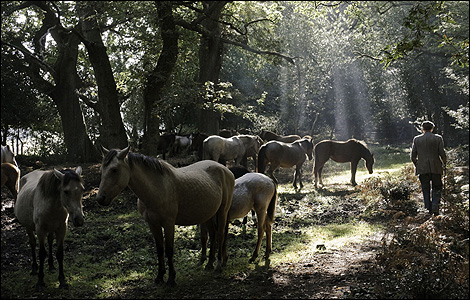 Ron Drodge in woods at East Boldre (Sally Fear) New Forest photograher Sally Fear's latest compilation of photos is a tribute to the commoning way of life that has helped conserve the familiar landscape of the New Forest. The origins of commoning go back into the mists of medieval history to the time of William I when landowners were given certain rights to compensate for the New Forest being managed as a royal hunting ground without fences or boundaries. These included the Right of Pasture - to graze cattle and ponies on open forest land. This year marks the centenary of the New Forest Commoners' Defence Association, set up in 1909 by Lord Arthur Cecil to ensure the continued maintenance of the forest, and cope with the pressure of outside visitors on the environment being felt even then 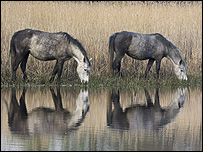 Ray Readhead’s grey mares grazing at Beaulieu Sally's new collection of photographs features commoners at work, their animals in the forest and historical photographs reflecting commoning in years past. She is also a commoner, running four ponies on the open forest from her smallholding in Brockenhurst. She wants to raise awareness that commoning is fundamentally important to creating the forest landscape enjoyed by thousands of visitors each year. "If there were no animals on the forest, within a year it would be overgrown and it wouldn't be the New Forest they know today where they bring their barbeques and walk their dogs. It would be a jungle if it wasn't for the animals browsing and grazing, and the animals are owned by the commoners." Although the New Forest is any photographer's dream location, Sally is keen to stress that her shots are more than 'picture postcards': "I'm interested in communities and ecology. I don't take pictures just to hand on a wall, I take them to communicate a message." 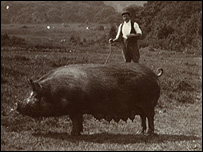 A commoner in 1906 (Christopher Tower library) The message is that pressure on the New Forest, in particular the fact that 150 commoners' animals are killed on the forest's roads every year, mainly due to careless drivers: "People have to remember that the animals have right of way - when an animal chooses to cross the road, they still have right of way. They may be making you late, but they have right of way." Sally hopes that the book and exhibition will help visitors recognise the hard work and passion of Commoners: "The animals may be wild in that they take care of themselves, but they are all still owned by someone. People should value the commoners and commoning and be more careful of their animals." The Commoners' New Forest Exhibition - 6 June to 26 July 2009 - The New Forest Centre. Book published on 6 June.last updated: 05/06/2009 at 11:05 You are in: Hampshire > Nature > Nature features > New Forest > The commoning touch   
| ||||||||||||||||||||
| | About the BBC | Help | Terms of Use | Privacy & Cookies Policy |

