 | 13 November 2014 |

| |
| BBC Homepage | | |
| |||
| Contact Us | | |
Nature featuresYou are in: Hampshire > Nature > Nature features > Take flight this spring...go birding 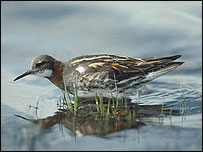 The red necked phalarope (© RSPB) Take flight this spring...go birdingIndy Almroth-Wright Spring sees the Hampshire and Isle of Wight coastline's bustling with the arrival of thousands of birds back from their winter haunts - but you may also spot rarities and even the odd exotic misfit! Derek Lister is a RSPB volunteer, he's been birdwatching for over 40 years and runs Chandlers Ford Falcons, a monthly a wildlife group set up for children aged 8-13 and their parents. A birdwatcher's dream"We're lucky in Hampshire because we've got all the habitats; in the New Forest we've got the unique heathland. We've also got coastal reserves like Titchfield Haven with reed beds. "Marsh areas like Farlington Marsh and Keyhaven are key areas for migrants to feed when they arrive - before they move on up the country to their breeding grounds." 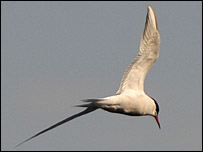 The tern makes an epic 18,000 mile journey As spring arrives, large numbers, or 'falls' of migrants start to appear - below Derek highlights some of the feathered friends you might be lucky enough to spot in Hampshire and the Isle of Wight this spring and summer. Long-haul junctionOn the south side of the Isle of Wight, St Catherine's Point is an excellent site for watching migrating sea birds. Highlights are the arctic skuas and terns as they make the last leg of their journey from Africa along the channel to breed in Scandinavia, Norway and Sweden. In April you can see them streaming by for a couple of weeks, and in the autumn they come the other way as they set off. For the terns it's part of an annual trip of more than 30,000 kilometres (or 18,000 miles) across the globe. 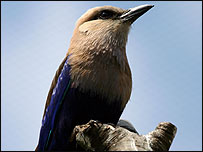 Blue-bellied rollers have been seen on the Island Exotic overshootsAlong the south coast rare birds often over-fly their breeding areas or are blown off course by the weather, resulting in some exotic visitors. The Isle of Wight is a prime spot for unusual travellers. Past out-of-towners include rare warblers - the arctic warbler on its way to the arctic circle and a roller - a vivid blue and chestnut red tropical bird that somersaults in the air to catch insects. In Hampshire, one glamorous guest is the hoopoe - a dove-sized, vibrant pink and white bird with a curved thin bill. It looks like a bird from the tropics but it breeds in Europe - one or two are seen in the south every spring. 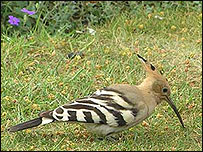 You might be lucky and spot a Hoopoe Farlington Marsh is a very popular landing spot for birds passing through on their way to the tundra. Look out for the curlew sandpiper and if you're lucky, the declining and rare red-necked phalaropes. 'Vlad the Impaler'In the New Forest, four great grey shrikes - birds that are very rare in Britain have taken up residence. About the size of a large thrush, they're quite ferocious little fellows as they feed on small mammals and other birds - even impaling them on a thorn to eat later! They'll be heading back to Scandinavia in April/May. 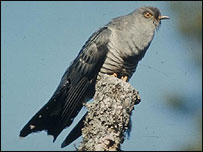 Cuckoo's are very fond of hairy caterpillars Tour leadersBack in Hampshire after an epic flight from Africa are the sand martins. One of their favourite spots is Blashford Lakes near Ringwood - but you can see them along any banked coastline. They burrow through the bank into a hole and lay their eggs. When to see: March to October. Early April sees the cuckoo come up from the tropics of Africa and stay until July. The cuckoo is the iconic noise of spring, they come to Hampshire because they like to be near reeds where they can lay their eggs in the reed warbler's nests. Keep your eyes peeled for a very rare version called the rufus cuckoo which instead of the usual slate grey is browny/red. Odd bird outLeucistic birds - which have a pale plumage but not pink eyes like an albino - often turn up in the south. 'White' blackbirds and thrushes are the most common - a blackbird with a black body and pure white head has recently been spotted on the Isle of Wight. 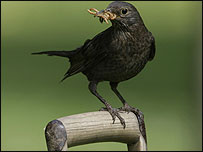 The blackbird which can also be white! ©RSPB A striking immigrant to the south is the cattle-egret - if you've watched an African safari documentary you'll have seen this bird which looks like a mini heron riding on the back of grazing animals. They've made their way up from Africa to Britain where you'll see them riding on the back of cows in Hampshire and Dorset looking for tasty insects, small reptiles and frogs to eat. If you fancy a spot of 'Birding' this spirng/summer, The Hampshire Ornithological Society, RSPB and Chandler's Ford children's wildlife group, The Falcons offer tips, walks, & field trips for their members. The BBC is not responsible for the content of external websites last updated: 23/03/2009 at 09:50 SEE ALSOYou are in: Hampshire > Nature > Nature features > Take flight this spring...go birding   
| ||||||||||||||||||||
| | About the BBC | Help | Terms of Use | Privacy & Cookies Policy |

