Our close relationship with bees dates back thousands of years and for good reason.
These little miracle workers are a vital part of the environment and the food chain.
Today the humble honey bee provides us with a significant proportion of the food that we eat, all thanks to its action as a pollinating insect.
And a large proportion of the world’s food supply is directly, or indirectly, affected by honey bee pollination.
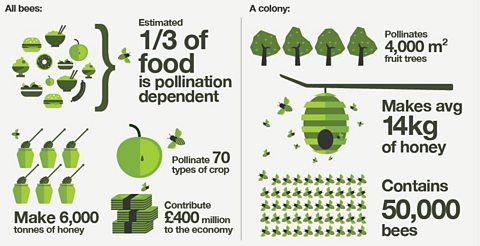
Here in the UK around 70 crops are dependent upon, or benefit from, visits by bees: think broccoli, think cabbage and the everyday apple.
But it’s not just the fruit and vegetables that we eat that have been pollinated by the bees it’s also the food that we feed to animals, which we in turn eat, that has been pollinated in a similar way.
And bees are important for many more reasons than just food.
Their responsible for the wax in our polish and the honey on our morning toast.
With one hive capable of producing more than 50kg of honey in a good season.
We all know that honey can help soothe a sore throat but now we also know that this stuff has anti-bacterial qualities too.
And of course bees play their part in pollinating the flowers that make our gardens come alive in the summer.
It really is worrying then that these very special insects are in decline.
The importance of bees
Ever wondered where all the food that you eat comes from? Well it might surprise you that a significant proportion is provided by bees one way or another.
If you look at the plate of food on your dinner table, bees have played their part either pollinating the many vegetables and fruits we eat directly, or pollinating the food for the animals that we then consume. And that’s not all bees do for us - honey and wax are two other important products that come courtesy of bees.
But honey bees are disappearing globally at an alarming rate due to pesticides, parasites, disease and habitat loss. If these little insects that help provide so much of the food we eat were to vanish, what would we do without them?
What bees do for us
An illustration of what all honey bees, and a colony of honey bees, do for us in the UK each year. However, pollination is from all invertebrates, of which honey bees are a significant contributor.
Pollination and food production
Pollination is the vital process in flowering plant reproduction involving the transfer of pollen grains from the anther (or male part) to the stigma (or female part) of the same, or another plant of the same species.
The fertilised egg cells grow into seeds which are then spread in the many fruits and vegetables that we all love to eat.
This transfer of pollen can be done by the wind, birds, bats, mammals and of course insects; one of the most important of these are the honey bees that pollinate on a huge commercial scale. All sorts of fruit and vegetables are pollinated by honey bees, such as broccoli and squash, apples and almonds.
Pollination is not just important for the food we eat directly, it’s vital for the foraging crops, such as field beans and clover, used to feed the livestock we depend on for meat. Just as importantly, it helps to feed many other animals in the food chain and maintains the genetic diversity of the flowering plants.
Watch Alan Titchmarsh explain the importance of bumblebees in pollinating crops on an industrial scale. [Archive clip from the BBC Two series, 'Nature of Britain', first broadcast in 2007.]
The threats to honey bees
There is no doubt that honey bee populations are in trouble as Chris Packham explains in more detail below.
Image copyrights: number 3 (varroa mite) SINCLAIR STAMMERS / naturepl.com, number 5 (man holding dead bees) Laurent Geslin / naturepl.com, numbers 8, 9 and 10 Impossible Factual / Stephen Moss and all others courtesy of Getty.
Why honey bees are under threat?
Audio transcript for slideshow presented by Chris Packham
Honey bees feature almost weekly in the news.
Headlines reporting on their demise include the dangers pesticides, parasites spreading disease and habitat lose.
Much of the blame is being put on a group of insecticides containing neonicotinoids which affect not just bees but many of our other native invertebrates.
The use of neonicotinoids on flowering crops attractive to bees has now been temporarily banned in Europe.
Meanwhile the parasitic varroa mite is spreading disease; a bite from these mites injects the deadly Deformed Wing Virus into the bees blood and can destroy an entire honey bee colony.
It’s been described by scientists studying its effects as one of the most widely distributed and contagious insect viruses on the planet.
All of these factors may be playing a role in the catastrophic Colony Collapse Disorder, which is where very few or no adult honey bees are fund in the hive.
This has massive consequences for our food supply and economy, with potential loses reaching billions of pounds.
At the moment not all the reasons that honey bees are under threat are understood.
It seems unlikely that we would lose them forever as most pollinating colonies of honey bees are now managed.
But if the worst were to happen and we lost our honey bees there are ways of filling their pollinating role.
