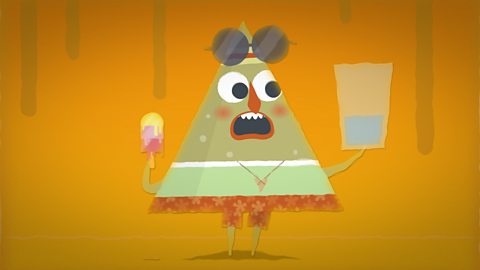
Breakfast time, eggs-cellent!
Sorry! Anyway, some changes we make to materials are irreversible. So once the change has happened, we can't go back again.
If you crack an egg in a frying pan and heat it up, that's an irreversible reaction. You're never getting that raw egg back now.
Mixing water, sand and cement, that's an irreversible change. I'm guessing nobody explained that to you. Well, when you put the three together, you get concrete. It sets very hard and can't revert back to being soft again.
Burning can also cause an irreversible reaction, obviously under strict adult supervision. Cheers, Dad. If you burn paper, you get smoke and ash, and you can't write or draw on that.
Hey, what are you burning there? Oh, brilliant. It's the safety instructions from the cement mixer. I think we're going to have to cut you out. I don't think that's going to cut concrete, I'm afraid.
How's your egg?
Whoops.
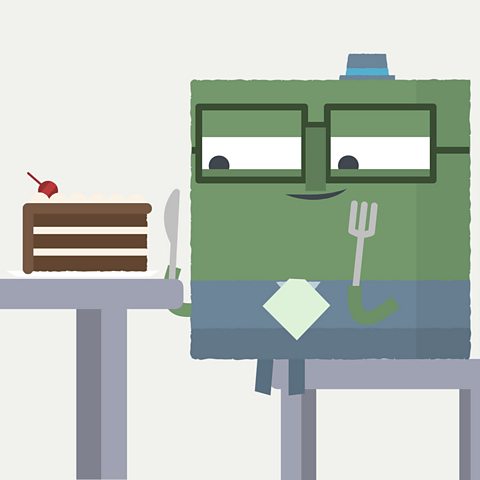
Irreversible changes
A change is called irreversible if it cannot be changed back again.
In an irreversible change, new materials are always formed. Sometimes these new materials are useful to us.
Heating
Heating can cause an irreversible change. For example you heat a raw egg to cook it. The cooked egg cannot be changed back to a raw egg again.
Mixing
Mixing substances can cause an irreversible change. For example, when vinegar and bicarbonate of soda are mixed, the mixture changes and lots of bubbles of carbon dioxide are made. These bubbles and the liquid mixture left behind, cannot be turned back into vinegar and bicarbonate of soda again.
Burning
Burning is an example of an irreversible change. When you burn wood you get ash and smoke. You cannot change the ash and smoke back to wood again.
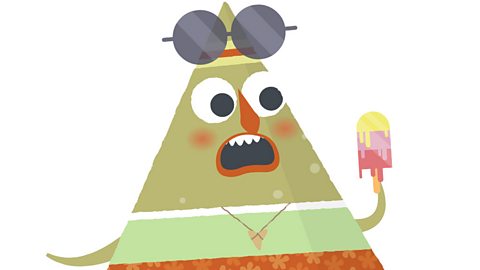
Reversible changes
Reversible and irreversible reactions are different.
A reversible change is a change that can be undone or reversed.
If you can get back the substances you started the reaction with, that's a reversible reaction.
A reversible change might change how a material looks or feels, but it doesn't create new materials.
Examples of reversible reactions include dissolving, evaporation, melting and freezing.
Times tables 1-12!
Practise the times tables with our songs, videos and quizzes
More on Materials
Find out more by working through a topic
- count3 of 8
- count4 of 8
- count5 of 8
- count6 of 8