 | 13 November 2014 |

| |
| BBC Homepage | | |
| |||
| Contact Us | | |
Nature FeaturesYou are in: Guernsey > Nature > Nature Features > Tracking the gulls 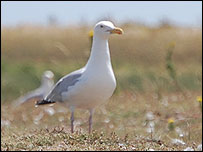 Gulls from Mont Cuet will be tagged Tracking the gullsThousands of sea gulls that feed and breed around the Mont Cuet landfill site will be tagged by researchers keen to track their movements. Eddie Parks caught up with Paul Veron from La Société Guernesiaise to find out more about the project. Paul told us how important gulls are to the island: "We tend to take them for granted, of course being islanders we see them every single day of our lives, but there's some very concerning things happening with gulls." Paul gave the example of the red herring gull which has been put on a list of endangered species. The red herring population has fallen by 50 percent in the last 20-30 years. A specialist team from the UK will be coming to Guernsey to tag the gulls. "They actually propel a net about 15-20 metres long by about 12 metres wide over the top of the gulls as they feed on refuse," explained Paul. A team of local bird ringers and enthusiasts will assist the UK team. The birds will be quickly extracted from the net and small coloured rings will be fitted on them so that individual birds can be identified without the need to ever catch them again. Paul caught and tagged a few birds last year. He even spotted one of these birds in the Algarve, Portugal while visiting there. The information collected from the project will be fed into the European network of scientific bird study and bird ringing. Paul suspects that some of the birds in the study will move around the island or move away from Guernsey. "It may be that we'll see lower chick productivity because there may not be as much food available ... even that is not known for certain and studies like this will really help us to find out this information." Help playing audio/video last updated: 04/06/2009 at 15:05 SEE ALSOYou are in: Guernsey > Nature > Nature Features > Tracking the gulls [an error occurred while processing this directive] |
| | About the BBC | Help | Terms of Use | Privacy & Cookies Policy |
