 | 13 November 2014 |

| |
| BBC Homepage | | |
| |||
| Contact Us | | |
Local HistoryYou are in: Guernsey > History > Local History > HMS Victory HMS VictoryFollowing the discovery of the wreck of the 18th Century ship in February 2009 we look at the history of the vessel. 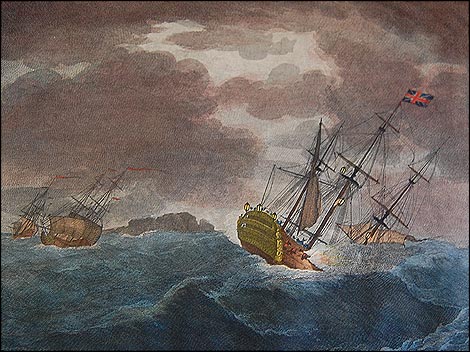 "A ship in distress" depicts Victory in the storm The predecessor of the famous HMS Victory, commanded by Admiral Lord James Saumarez in two Baltic campaigns and previously Admiral Lord Horatio Nelson at the Battle of Trafalgar, was hailed as the mightiest and most technically-advanced vessel of its age. The first-rate ship, meaning it had 100 or more cannon, was the largest ship in the world when she was launched in 1737 and two famous admirals, Sir John Norris and Sir John Balchin, called her their flagship. In July 1744 Admiral Sir John Balchin was called out of retirement, which he had barely begun, to lead a force to liberate a vital supply convoy blockaded by a French fleet down the River Tagus at Lisbon, which he commanded from HMS Victory with a hand-picked crew. After chasing the French fleet away, HMS Victory escorted the convoy to Gibraltar before heading back to Plymouth. She was transporting £400,000 worth of gold for Dutch merchants and goods from ships they captures on the voyage home when she disappeared with all hands during a violent storm in the English Channel in the early hours of 5 October 1744. 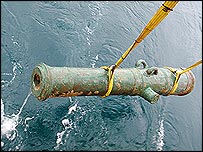 42 pounder cannon leaves the sea. Pic: Odyssey Besides the loss of Admiral Sir Balchin and Captain Samuel Faulknor there were at least 900 sailors, at least one unit of marines and 50 midshipmen, young gentlemen who had volunteered to serve under the famous admiral on his last voyage. On that morning Alderney fishermen are reported to have heard cannon fire, in stormy weather a sign of a ship in distress, from the area around the Casquets and it was assumed that the only ship from the fleet that did not arrive in Plymouth had floundered on these infamous rocks lying north-west of Alderney. During the following days wreckage was found including clothes marked Cotterell the name of the Captain of Marines by Alderney fisherman and spars, topmasts, gun carriages and an oar all marked Victory. The loss of the most advanced ship in the world produced a state of shock and based on the theory above questions were asked about Admiral Sir Balchin's suitability to command and Alderney's lighthouse keeper was accused of not lighting the beacon. ExonerationThe discovery of the site by Odyssey Marine Exploration "nearly 100km from the Casquets" suggests the ship sank as the result of the violent storm and that aspects of her design, which was criticised at the time for a lack of stability and high centre of gravity, may have been partly responsible. As the only ship of her design in the fleet was the only vessel that sank and the next HMS Victory was similar in its dimensions but was designed differently to be more seaworthy bears this out.
The BBC is not responsible for the content of external websites last updated: 04/02/2009 at 18:10 SEE ALSOYou are in: Guernsey > History > Local History > HMS Victory [an error occurred while processing this directive] |
| | About the BBC | Help | Terms of Use | Privacy & Cookies Policy |
