| 13 November 2014 |

| |
| BBC Homepage | | |
| |||
| Contact Us | | |
Prince Edward to Ynys MonYou are in: Guernsey > Island Games > A-Z of Islands > Prince Edward to Ynys Mon > The Shetland Islands 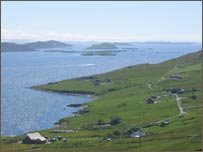 Western Shetland Isles The Shetland IslandsThe Shetland Islands is a cluster of more than 100 islands situated on a sea crossroads between Scotland and Scandinavia. Despite Shetland's remote location, air and sea transport operators provide very good services to the Scottish mainland and during the summer months air and sea links are maintained between Shetland and Bergen in Norway. The census in 1991 recorded a population of 22,522, with almost one-third of the population (7,220) living in Lerwick, Shetland's capital. Shetland is now under Scottish control but in 1469 the royal estates and prerogatives in Shetland and Orkney were pledged to Scotland as part of the marriage dowry between Margaret, daughter of the King of Denmark and Prince James of Scotland. The conditions were that the islands would revert to rule by the Kings of Norway when the debt was paid, however the pledge was never redeemed and the Northern Isles remained under Scottish control. To this day, in theory, Denmark can still redeem her mortgaged territories, and much of the Norse culture still continues to influence the culture, traditions and dialect of Shetland even today. English is the official language spoken. However the Shetland dialect is very distinctive and has in fact been formed by four languages, Norse and Scots with traces of Dutch and German. Up to about 300 years ago, Norse was the main language of the islands and today over 50,000 Shetland place names still exist of Norse origin. The 1970s saw the arrival of the oil industry which gave a massive boost to the economy, especially during the construction phase and the building of Sullom Voe Oil Terminal, the largest oil and liquefied gas terminal in Europe. A more recent and rapidly growing industry is salmon farming with Shetland’s clean waters providing ideal conditions for this purpose. Tourism is also becoming increasingly important with the magnificent scenery, abundant wildlife and intriguing heritage drawing many visitors to the islands. In recognition of the importance of sport and leisure activities to the health and well-being of the population, the Shetland Islands Council has supported voluntary sports groups over the last 20 years by means of a comprehensive grant-aid scheme and the development of a number of new sports facilities. There is now a network of leisure centres and swimming pools throughout the islands funded largely through oil-related monies and administered by the Shetland Recreational Trust. The Clickimin Leisure Centre, situated in Lerwick is the main facility and since it opened its doors in 1985, it has proven to be a major attraction to both locals and tourists alike. In addition to a multi-purpose sports hall (1,000 square metres), fitness suite, sauna and solarium, multi-use studio, shooting gallery, football, hockey and rugby pitches and an all-weather athletics track, the complex now has a four-rink indoor bowls hall, leisure pools and a 6-lane 25m swimming pool with floating floor. Medals in the 2007 Games in RhodesGold: 2 Medals in the 2005 Games in ShetlandGold: 10 Medals in the 2003 Games in GuernseyGold: 4 last updated: 25/06/2009 at 08:49 You are in: Guernsey > Island Games > A-Z of Islands > Prince Edward to Ynys Mon > The Shetland Islands |
| | About the BBC | Help | Terms of Use | Privacy & Cookies Policy |