| 13 November 2014 |

| |
| BBC Homepage | | |
| |||
| Contact Us | | |
Prince Edward to Ynys MonYou are in: Guernsey > Island Games > A-Z of Islands > Prince Edward to Ynys Mon > The Western Isles 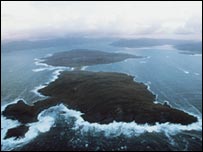 Taransay from the air The Western IslesAlso known as the Outer Hebrides, The Western Isles is a chain of over 100 islands located 55 km off Scotland’s West Coast. The principle islands, Lewis & Harris, Taransay, Berneray, North Uist, Benbecula, South Uist, Eriskay, Barra, Vatersay, Sandray, Pabbay and Mingulay stretch out from north to south for 210 km. Most famously the Western Isles are the home of Harris Tweed which is still hand woven in the islands today. Samuel Johnson, the father of the English dictionary, and his friend James Boswell recorded their tour of the Western Isles in the 1770s. More recently the BBC’s Castaway 2000 programme followed 36 people, including the now famous Ben Fogle, living a back-to-basics lifestyle on the Hebridean island of Taransay. The Western Isles are home to 26,500 people (2001 census) a third of whom live in the capital Stornoway on the Isle of Lewis. Much of the available work comes from public sector roles such as healthcare and education, whilst the fishing, fish farming, tourism construction and logistics industries combine to employ a significant proportion of the workforce. In 1266 the Western Isles were returned from Norse control to the Scottish crown. With the formation of the United Kingdom the islands were governed from London until the devolution of power to Edinburgh in 1998 and the formation of the Scottish Parliament. Water dominates much of the islands, as inlets, beaches, bays and lochs shape the coastline and inland areas of the Western Isles. The islands are also the site of important prehistoric human activity. Archaeologists have found stone circles, cairns and other monuments across the islands, while the famous Standing Stones of Calanais pre-date England’s Stonehenge monument. In 1266 the Western Isles were returned from Norse control to the Scottish crown. With the formation of the United Kingdom the islands were governed from London until the devolution of power to Edinburgh in 1998 and the formation of the Scottish Parliament. One of Europe’s most precious types of grassland is to be found in abundance on the Western Isles. Low-lying grassland known as ‘Machair’ is found in areas of Western Ireland and Scotland and is home to many rare or vulnerable plants and birds. Recently a programme removed and re-homed hundreds of introduced hedgehogs which had been feasting on the eggs of ground nesting birds. Stornoway’s Nicholson Lewis Sports Centre was opened during 2004 after a significant rebuilding programme replaced the previous facilities. Islanders can now use a 25m pool, 6 lane running track, fully equipped gym, a multi-purpose sports hall and two squash courts. In Lionacleit on North Uist, a local centre provides opportunities to take part in sports, as do many community facilities across the isles. For the those looking for the ultimate challenge in outdoor multi-sports, the Hebridean Challenge combines running, road and mountain biking, sea swimming and kayaking for teams or individual competitors. Medals in the 2007 Games in RhodesGold: 1 Medals in the 2005 Games in ShetlandGold: 0 The 2005 Island Games was the first ever for the Western Isles. last updated: 25/06/2009 at 09:07 You are in: Guernsey > Island Games > A-Z of Islands > Prince Edward to Ynys Mon > The Western Isles |
| | About the BBC | Help | Terms of Use | Privacy & Cookies Policy |