 | 13 November 2014 |

| |
| BBC Homepage | | |
| |||
| Contact Us | | |
ProfilesYou are in: Guernsey > People > Profiles > Timeline of Victor Hugo 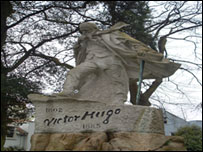 Victor Hugo Statue. Timeline of Victor HugoThe literary and political genius was one of the most famous people to have lived in Guernsey while he was exiled from his homeland. 1802February 26: Hugo is born in Besancon, France. 1815 - 1818Attends the Lycée Louis-Le Grand in Paris. 1817Honoured by the French Academy for a poem he wrote and wins first place in a national poetry competition. Hugo was an excellent student who excelled in mathematics, physics and philosophy. 1821Hugo's mother dies. 1822His first book, Odes et Poésies Diverses (Miscellaneous Odes and Verses) is published. Wins a pension of 1,000 Francs a year from Louis XVIII. Marries Adele Foucher who becomes the mother of his children; Leopold-Victor, Charles- Victor, Francois-Victor, Adele and Leopoldine. 1823His first novel, Han d'Islande (Han of Iceland) is published. 1824Bug-Jargal is published. 1826Odes et Ballades (Odes and Ballads) is published. 1827Cromwell, Hugo's play is published and in the foreword, he wrote about gaining freedom from the classical restrictions. This started the debate between French Classicism and Romanticism. 1830Hugo became one of the leaders of a group of Romantic rebels who were trying to loosen the hold of classical literature in France. His play Hernani is published in this same year, took a large step towards a more realistic theatre and made him a rich man. 1831Hugo's next book, Notre-Dame de Paris (The Hunchback of Notre Dame) is published. This book, not only increased his popularity and reputation as the greatest writer in France, but also brought about his election to the French Academy in 1841. 1833Actress Juliette Drouet became his mistress and supported by a small pension, she became his unpaid secretary and travelling companion for the next fifty years. 1843In this year Hugo's daughter Léopoldine was drowned, along with her husband and his play Les Burgraves was a failure. For the next few years, Hugo decided to focus on the growing social problems in France and did not write at all. 1845As his father had been a Napoleonic General, he had become a Royalist as a young man. In this year, he was made a peer of France by King Louis Philippe. 1848The year of the French Revolution. By now, Hugo was a Republican and had been elected with the new formation of the Second Republic, to the French Constitutional Assembly and to the French Legislative Assembly. Here Hugo was an avid advocate of social injustice. 1851After the unsuccessful revolt against President Louis Napoleon (later Emperor Napoleon III), when Hugo risked execution by trying to rally the workers of Paris against the new Emperor, he fled to Brussels. 1852It was clear, however that as a close neighbour of France, the Belgian authorities were concerned that Hugo's political statements would strain relationships between the two countries so during this year Hugo moved to Jersey. Napoléon Le Petit (The Little Napoleon) is published. 1853Hugo's best known works of poetry, Les Chatiments (The Punishments) is published. 1855Queen Victoria's visit to Paris caused a highly satirical article to be published by French exiles in a London newspaper and the contents of the article were repeated by some of Hugo's fellow proscribed in the newspaper they had found in Jersey. This led to three of them being expelled. Declaring his own solidarity with them led subsequently to the expulsion of Hugo himself and he arrived in Guernsey at the end of October. 1856Les Contemplations is published. This book of poetry was an immediate success and with the proceeds, he bought 38 Hauteville in St Peter Port, now more commonly known as Hautevillle House. 1862Les Misérables, his longest and most famous work is published. This novel is about the social injustice of 19th century France in which the main character, Jean Valjean, is sentenced to prison for 19 years for stealing a loaf of bread. 1870After the Franco-Prussian War and the fall of the Empire, Hugo made a triumphant return to Paris. Here he resumed his role in politics and was elected to the National Assembly. 1876Hugo is elected to the Senate, but poor health meant that he returned to Guernsey. 1885May 22: At the age of eighty-three, Victor Hugo died in Paris June 1: He was given a national funeral attended by over two million people. His body was laid in state under the L'Arc de Triomphe and he was later borne on a pauper's hearse, in accordance with his wishes, to be buried in the Panthéon, the burial place of many great French people. last updated: 19/02/2009 at 15:38 You are in: Guernsey > People > Profiles > Timeline of Victor Hugo [an error occurred while processing this directive] |
| | About the BBC | Help | Terms of Use | Privacy & Cookies Policy |
