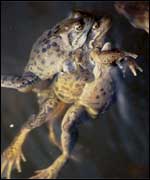
Are you worried that youll be overrun by a veritable plague of tadpoles and froglets this spring? Well, dont panic because expert advice is available from environmental advisor Colin Green. The familiar sight during Spring is the garden pond coming alive as frogs hook up for the first time to spawn after their long winter hibernation. Colin explains: "People tend to panic around this time of year because frogs are coming out of hibernation, they're going down to the pond and what they've obviously got their mind on spawning. "The average female will lay about 3,000 eggs. If you've got a female there, you've got a huge amount of frog-spawn." Loads of frogs ... not! With around 3,000 eggs from one breeding female, you'd imagine your garden pond would be rammed with growing frogs. However, this isn't the case as Colin reveals: "Now if you're not sure about the ecology of frogs, the first thing that pops into your mind when you see the frog-spawn is 'goodness me, by the summer I'm going to be up to my armpits in frogs!' "We know for a fact that, out of the 3,000 eggs, something like five might make it to be an adult. It's not a lot when you think about it. "Literally everything gets eaten by all sorts of predators. In the pond there will fish, including goldfish, who will eat them. Newts, water beetles, dragonflies and nymphs will eat them. We're talking about the tadpoles here." The pond seems like a dangerous place for these growing frogs but life doesn't get much easier on land either. Colin explains: "If they're lucky enough to make it onto land then other creatures will be eating them. Everything from foxes to hedgehogs to rats - a variety of animals will feed on them. "This is why so much spawn is laid at the beginning of the year. The young frogs not attended to by their parents, they're left to fend for themselves so they compensate by laying huge amounts of spawn." A passion for frogs Colin has a real passion for frogs, that comes from his study of their extraordinary life cycle. How they've evolved is something he finds truly fascinating. He says: "I've always had a passion for frogs, and toads I hasten to add. They amaze me. As human beings we tend to think we're pretty good in the animal world but forget it. But you look at a frog - it starts off as an egg in water, then develops into a tadpole with a tail and gills. Then a matter of weeks after that the back legs start to appear and the tail starts to disappear. It then grows a front pair of legs, develops a pair of lungs and crawls out onto the land. Wow - is that mind blowing or what! That really makes we think that evolution has worked overtime here. "Also, at the same time, they can do wonderful things like breathe through their skin at the bottom of a pond through water. That is just amazing. They can jump up to seven times their own body length - all these things make me in awe of this particular creature." Frog-spawn in your pond If you've found that your pond is loaded with the jelly-like mass of frog-spawn then you might be tempted to clear it out or take it by bucket to the nearest pond and dump it. But, according to Colin, his is the wrong thing to do. He says: "One question I get asked quite often is 'can I remove the frog-spawn?'. The answer is that is shouldn't really be moved. The reason is that you might be moving disease. There is a disease called Red Legs in frogs - you may not have that in your pond but you don't know, you might be moving that disease around. "Under no circumstances do you move frog-spawn from a garden pond to a wild pond. The reason why is not only the disease factor but because you have to consider that your pond might have some aquatic plants in it which are not native to Britain and you might be transporting their seeds in the spawn. If you do that you might be upsetting the complete ecology of that wild pond, and most probably end up destroying it. "Leave spawn in you pond as nature will literally take care of it in its own way - it will be the hamburger in the food chain. Everything will be eating it and you'll be left with one or two." Good for your garden Colin believes that frogs are nature's friend and that they play an important part in maintaining a natural balance in our gardens. They're not a pest, in fact the opposite - they're actually really good for your garden. He reveals: "Frogs are pretty good in the garden, they're great biological controllers because they feed off slugs and snails for instance. So it's pretty important to have a few in your garden." 
If you would like to comment on this story get in touch at gloucestershire@bbc.co.ukor have your say on our messageboard | 




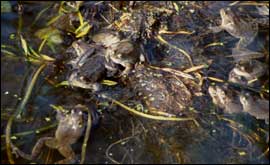
 Colin Green is the environmental advisor for Severn Trent Water and he has a passion for frogs. In this feature he talks about our amphibian friends ...