| 13 November 2014 |

| |
| BBC Homepage | | |
| |||
| Contact Us | | |
ProfilesYou are in: Gloucestershire > People > Profiles > A carer's story 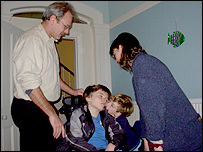 The Martel family A carer's storyJacky Martel It can be a full-time job looking after a loved one. A job that has no perks, rewards and can be very demanding. Jacky Martel, from Stroud, looks after her son and explains how hard her life can be. Tomas is the eldest of our three boys; he is ten and has severe and complex disabilities.
We do not have a diagnosis for Tomas, no label or name, just a list of issues – he has a severe learning disability, challenging behaviour, severe communication difficulties and is still pre-verbal and does not use signs or gestures, he has a severe sleep disorder, has a range of sensory sensitivities, a tendency to self-harm when upset and is very likely on the autistic spectrum but it is difficult to diagnose formally with so much else going on. He also has pica – which is the eating or putting in mouth of non-food items – so everything goes in Tomas’s mouth and gets well chewed. This can be the phone bill, his brothers homework, small dinosaurs to swallow or poisonous plants – which can be half the garden but it isn't usually a problem as they taste very bitter but this seems to be a bonus for Tomas. VigilantThe result is a cross between a bull in a china shop and a toddler in a room full of marbles – especially worrying when he goes to put a bit of the mug that he has just knocked on to the floor and broken into his mouth. The result is a heightened state of alert and obsessive vigilance whenever Tomas is awake (which at times has been for 36 hours in a stretch). Tomas' brothers are only four and seven but know to keep their toys up stairs and the gate closed and pens and paper in the kitchen with the door closed and certainly no food near Tomas unless they want it stolen. 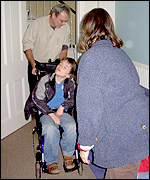 The Martel family As he has got taller the safe areas in the living room have got fewer – we can no longer pop a cup of coffee on the mantle piece while we rescue the newspaper from being shredded and eaten and this week the piano lost its value as I found Tomas picking up a pair of scissors from the top of it and checking what they tasted like. Even in our house which we have made as Tomas friendly as possible you can't switch off or relax completely, in other peoples houses, and recently even in the children’s hospital in Oxford, time with Tomas running around feels like an endurance test. DemandingEvery day has the added pressure of meeting Tomas' care needs. He is in nappies and unable to dress himself and often reluctant to be changed so even two people can struggle and the impact on you physically is high. He needs one-to-one help to eat, either spoon feeding or passing finger food a piece at a time so that it isn't squished and thrown on the floor. This adds quite a lot of time in the morning and particularly after school when Tomas is usually very hungry and has snacks and then tea. It also takes a lot of patience which you don't necessarily have much of after very little sleep or a great deal of hair pulling and pinching as you got Tomas dressed. Tomas is also challenging because he can walk and so isn't wheelchair bound but only walks when he chooses and in the direction he wants to go. 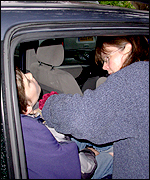 The Martel family StressWe obviously need to encourage Tomas to walk as much as possible and to co-operate and chose to comply with where we are leading him but if he decided to drop to the floor there’s not much you can do if you are on your own. This can be very stressful as it's usually as you are trying to get all three boys out of the house to get to a doctors appointment or something that he decides he’s not moving so you end up heaving him up against all good manual handling practice and regretting it for the rest of the week, or arriving half an hour late after much cajoling. This is just a bit of the day-to day issues, many we don't even realize are different as it's how it's always been. The less frequent issues have included months of screaming 24 hours a day at 100 decibels; having to change his wet bedding every day for weeks because his nappies were too small and we were waiting for the next delivery; being late for Easter Sunday lunch at the grandparents because we had to scrub the carpet, walls and windows three times after a dirty nappy came off in the night; trying to figure out how we can keep him from whacking the television with full force after he broke the old one – the list goes on and on. LuckyWe are also amongst the few lucky ones who get help - currently we get a direct payment from social services which means we can employ a care worker to help in the mornings and evenings when one of us is at work. We wouldn't have coped and stayed together as a family if we hadn't had this help but it has had its own cost as it has taken a lot of fighting for due to the lack of resources for families with disabled children. We are also very fortunate currently as we both work part-time for employers who are flexible and sympathetic to the issues we face. Many families aren't so fortunate and so the caring role falls entirely on one parent and money is an on-going added stress. The Carer's Allowance is only £50.55 per week and you get nothing if you earn over £95 per week and nothing once you become a pensioner. For this you must be caring for someone for at least 35 hours per week so it's a fraction of the minimum wage for a job that entails physical care for someone, emotional stress, physical health problems, mountains of paperwork, isolation and very limited or no time off. If our family failed to cope it would cost the state many, many times more money to support Tomas than it does helping us manage on a day to day basis. last updated: 05/12/2008 at 06:05 Have Your SayHave you faced similar challenges to Jacky? How have you managed to cope? Said Faramawy Graham Ponting You are in: Gloucestershire > People > Profiles > A carer's story |
| | About the BBC | Help | Terms of Use | Privacy & Cookies Policy |