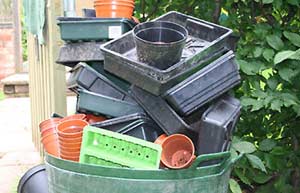
The effects of using plastic pots
The trouble is that, like carrier bags, plastic plant pots have become a huge waste problem: they pile up, in our gardens, in our bins, and the majority of them are either sent to landfill or incinerated. And the manufacture of virgin plastic uses significant amounts of fossil fuels (four per cent of the world's annual oil production is used to produce plastics and a further three per cent to manufacture them).
An obvious alternative is to recycle them, not just by giving your surplus to neighbours or a local community project, but by being able to take them back to be recycled commercially, ideally to be made into more pots. Until recently, the argument against recycling on a large scale has been that it's too complex and costly to sort the mixed plastics. But now the majority of plant pots are made from polypropylene, with trays made from polystyrene, and advanced technology means that mechanical sorting is feasible. However, Steve Griggs of Associated Polymer Resources points out that the specialized machinery is very expensive.
The challenge for gardeners is to persuade garden centres and nurseries to take back used pots - this will entail them providing staff to sort, stack and shrinkwrap them - and set up a collection scheme with one of the country's specialist plastic recyclers who can clean and granulate the plastic so that it can be re-used. Some enterprising independent garden centres, such as Groves in Bridport, have already set up schemes, and Wyevale have collection bins at all its 121 garden centres.
Using degradable plastic - plastic which has been treated with an accelerant so that it will degrade when finished with - throws up problems of emissions and the length of time it takes to break down. And, according to Friends of the Earth, does nothing to promote lasting solutions to plastic waste.
Biodegradable pots, made from a range of materials such as coir, wood chips, rice husks, miscanthus or seaweed, are becoming increasingly popular, especially with organic gardeners. There are two types: ones that last a few months and can be planted straight into the soil, where they gradually break down and add humus to the soil; and more rigid ones made from plant materials such as rice husks and latex which last up to three years and can be put on your home compost heap to degrade. Gardeners' World presenter, Alys Fowler, has tried both kinds and found the miscanthus-based ones fell apart too quickly. She is now successfully using the rigid ones which can be washed and re-used, but will break, she warns, if you drop them on the ground.
Caroline and Derek Taylor of the Hairy Pot Plant Company have recently switched to coir pots, which they describe as 'rustic looking', having trialled several other kinds for three years. The roots establish quickly and once they push through the sides of the pots are air pruned, which encourages them to branch more inside the pot. This avoids rootballing and creates a well-developed root system that enables the young plants to romp away, with no disturbance, as soon as they are planted out in their pots. Organic grower Mike Kitchen of Rocket Gardens has had similar success with compressed wood fibre pots from France, the largest of which, he says, can last for up to a year before degrading.
Both these kinds of biodegradable pots dry out more quickly than ordinary plastic pots, and need to be handled more carefully. Except for the ones you make yourself from newspaper, biodegradable pots are also more expensive and their manufacture has a carbon footprint. In the case of coir, which is mainly sourced from Sri Lanka, there's the extra transport costs, although very little energy is used in their manufacture as the coir is dried by the sun for most of the year. But as coir importer Joe Collinson explains: 'We should consider the social costs of what we're using too. In this case, the pots, which are finished by hand, provide a livelihood for communities in Sri Lanka.'
Did you know?
- Each UK household produces over 1 tonne of rubbish annually.
- The average net saving of CO2 from recycling plastics is estimated to be between 1 tonne and 1.5 tonnes CO2 equivalent per tonne of plastics.
- Worldwide, we produce and use 20 times more plastic today than we did 50 years ago.
- Plastics make up around seven per cent of the average household dustbin in the UK.
Viewpoint
Alan Knight, former Sustainability Director, Wyevale. "Recycling plant pots is a low carbon form of recycling as the material has already been manufactured and you're making use of lorries that would normally be returning empty to the growers. If we simplify the kinds of plastics we offer in our garden centres, it will make the recycling process even easier."
Caroline Taylor, The Hairy Pot Plant Company. "Coir pots provide valuable employment in an under-developed area of Sri Lanka and work brilliantly as a pot. Last year we grew 20,000 plants in them. You plant the whole thing in the ground so avoiding waste and giving the plant a great start in life."
David Gwyther, The Horticultural Trades Association Director General. "The industry has long been very conscious of the environmental challenge caused by used plastic pots, and has for many years been seeking both alternative materials and cost-effective collection and recycling schemes. There are no quick fixes to this problem. It continues to require diligent development and trial work. HTA is monitoring these activities and running its own investigative schemes. Current industry projects include a SEEDA funded waste reduction and recycling project, and recycling experiments by Hilliers and Bransford Plants. We are pleased that Wyevale too is running a pilot recycling scheme. Though we have no details of this at present, we would hope that it would add to the industry's developing knowledge on how to come up with real solutions to the problem."
What you can do
- Take any unwanted plastic pots to a garden centre that offers a recycling service. If your nearest centre doesn't offer one, suggest the idea to them.
- If you want to buy plastic pots (with or without plants in them) choose ones that are made from recycled plastic (such as Plantpak).
- Make your own seed pots from newspaper. Use cardboard tubes for seedlings that put out long roots, eg sweetpeas.
- Experiment with biodegradable pots, both ones that you can plant directly into the soil and ones which can be used over longer periods and that can eventually be put on the compost heap.